

If you’ve been shopping for a new AC in McAllen or anywhere in the Rio Grande Valley, you’ve probably seen the term SEER — and noticed that the higher the number, the higher the price tag. It’s easy to wonder whether that extra cost is really worth it, or whether you’re just paying for a marketing number.
Here’s the honest answer: for most RGV homeowners, a higher SEER unit pays for itself faster than almost anywhere else in the country. The math works in your favor precisely because of how hot and long South Texas summers are. Let’s break it down.
What Is a SEER Rating?
SEER stands for Seasonal Energy Efficiency Ratio. It measures how efficiently an air conditioner converts electricity into cooling over an entire cooling season. Think of it like gas mileage for your AC — the higher the SEER number, the more cooling you get per dollar of electricity spent.
As of 2023, the federal government updated the standard to SEER2, which uses a more accurate testing method. You’ll see both terms used — SEER2 is the current standard for new equipment, but the concept is the same. Higher is more efficient.
The minimum SEER2 allowed for new systems in the South is 14.3 SEER2 (roughly equivalent to the old 15 SEER). You can go as high as 20+ SEER2 on premium systems.
Why South Texas Amplifies the Savings
Here’s the key thing that most generic HVAC guides miss: the return on a high-efficiency unit depends entirely on how much you run it.
In Minnesota, a homeowner might run their AC for 3–4 months of the year. In McAllen, you might be running it 8–10 months. That massive difference in run time is why the math tilts so heavily in favor of high-efficiency systems for RGV homeowners.
Consider a simplified example. Say a standard 15 SEER2 system costs $8,500 installed, and a 20 SEER2 system costs $11,000 installed. That’s a $2,500 difference upfront. If that efficiency difference saves you $40–$60 per month on electricity (a reasonable estimate for a 2,000 sq ft home running the AC heavily in McAllen), you’re looking at a payback period of roughly 3–5 years — and then you’re saving money every month after that for the life of the system.
In a cooler climate, that same calculation might take 8–10 years to break even. Here, it often makes clear financial sense.
The Comfort Factor — It’s Not Just About Money
SEER ratings don’t just affect your energy bill. They also affect how comfortable your home feels.
Higher-efficiency units — especially those with two-stage or variable-speed compressors — run longer at lower capacity on mild days. That sounds counterintuitive, but it’s actually what you want. Longer run times at lower speed mean better humidity control, more consistent temperatures throughout the house, and less of that “blast cold, shut off, blast cold” cycle that single-stage systems are known for.
In South Texas, where humidity is a real factor in how comfortable your home feels, this makes a noticeable difference. A 20 SEER2 variable-speed system doesn’t just save you money — it makes your home feel genuinely more comfortable.
When a High-SEER Unit Might NOT Make Sense
There are situations where investing in the highest-efficiency system available isn’t the right call:
Your home has significant insulation or ductwork problems. If conditioned air is leaking through the attic or your ducts are poorly sealed, even the most efficient AC unit won’t perform like it should. In that case, addressing those issues first — or alongside the replacement — will deliver more impact than just buying a better unit.
You’re planning to sell in the next 2–3 years. If you won’t be in the home long enough to recoup the premium, a mid-tier unit may be the better financial choice.
The budget doesn’t work. A properly sized 15 SEER2 system installed correctly will serve you well. Don’t stretch yourself too thin. A quality installation of a mid-range unit beats a poor installation of a premium one every time.
What the Numbers Actually Look Like
Here’s a general idea of what efficiency tiers look like in today’s market:
- 14.3–15 SEER2 — Entry level. Meets federal minimums. Reasonable starting point, lower upfront cost.
- 16–18 SEER2 — Mid-range. Good balance of upfront cost and efficiency. Often the sweet spot for RGV homeowners on a budget.
- 18–21 SEER2 — Premium. Higher upfront cost, best long-term savings, best comfort. Variable-speed systems typically live here.
Your actual savings will depend on your home size, insulation, usage habits, and current electricity rates with AEP Texas.
How to Make the Right Call
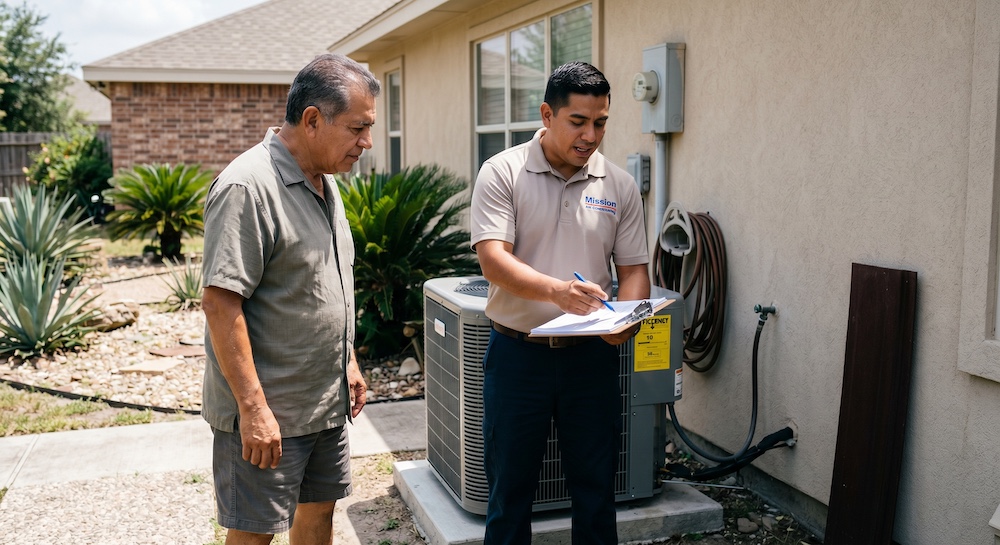
The best way to figure out what makes sense for your specific home is to talk through the numbers with a technician who knows the South Texas climate and can give you an honest comparison — not just push the most expensive option.
When you’re ready to replace your AC, ask your installer to show you the estimated annual energy cost difference between the systems they’re recommending. A good contractor will be happy to walk through that math with you.
Mission Air Conditioning works with RGV homeowners to find the right system for their home, budget, and long-term goals — whether that’s a mid-range system that does the job or a premium variable-speed unit that maximizes comfort and savings. We’ll lay out the options clearly so you can decide what makes sense for you.
Call Mission Air Conditioning today to get a free replacement estimate and efficiency comparison.