

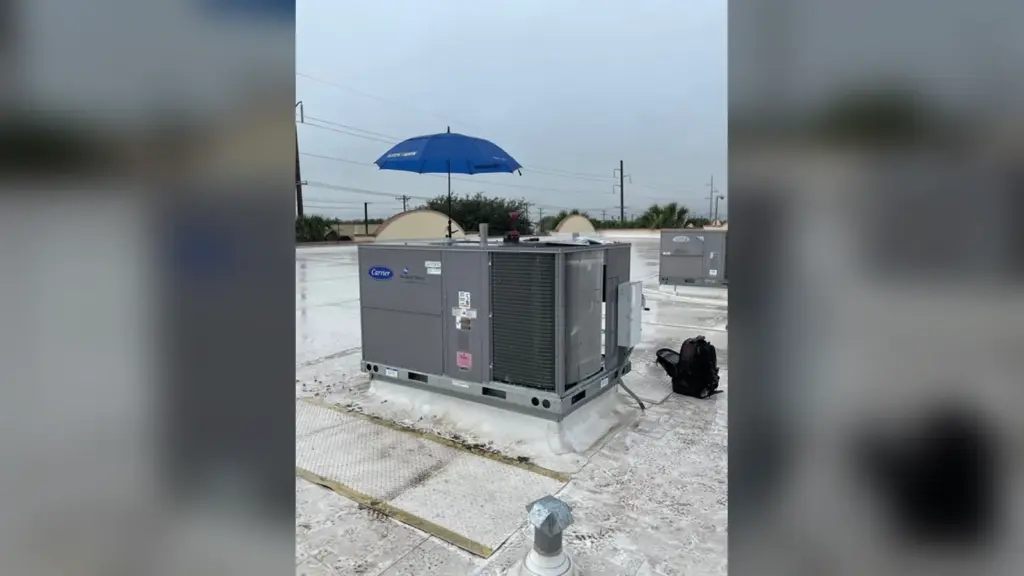
A commercial HVAC system needs two full service visits a year, one in spring and one in fall, with filters, coils and condensate drains checked every quarter in between. That is the shape of the commercial HVAC maintenance schedule in the National Renewable Energy Laboratory’s 2025 rooftop unit guide, which adapts its task list from ASHRAE’s commercial maintenance standard.
For a building owner in McAllen, the useful answer also covers when each visit happens and what gets done at it. A rooftop unit on a Valley retail strip or medical office runs through long, humid summers and a fall that stays hot, so a schedule copied from a Minnesota checklist will miss. This guide lays out a year of service for a McAllen building, task by task. If you would rather hand the calendar to someone local, Mission Air Conditioning works on commercial rooftop units in McAllen, Edinburg, Mission and around the Rio Grande Valley.
How often does a commercial HVAC system need service?
A commercial HVAC system needs attention every quarter, with the bigger inspections landing twice a year and once a year. NREL’s guide tells building owners to inspect rooftop units quarterly, semiannually and annually, and to keep a written log of every task.
Each layer has its own job:
Quarterly work keeps air and water moving. Filters get cleaned or replaced, coils get checked for fouling or fin damage, and the condensate drain and P-trap get checked for flow and growth.
Semiannual work keeps the unit in adjustment. Belts get checked for tension and wear, and the controls, safety devices and interlocks get tested and tightened.
Annual work looks deeper. The technician checks the compressor, the economizer and dampers, the ductwork, the fans and bearings, and the refrigerant lines for leaks.
Put together, the calendar works out to four visits a year, and two of them are the full spring and fall service.
Why do commercial systems follow a different schedule than homes?
Commercial systems follow a different schedule because the industry writes a separate maintenance standard for them. ANSI/ASHRAE/ACCA Standard 180 sets minimum inspection and maintenance requirements for commercial buildings, and its scope specifically excludes single-family houses.
The equipment is different too. The U.S. Energy Information Administration found that 66% of air-conditioned commercial buildings in hot climates use packaged units, the self-contained boxes most people call rooftop units. A packaged unit carries its whole system in one cabinet. Compressor, coils, blower, belts and drain all sit together on the roof, so one visit can reach every part, and every visit should.
The load is heavier as well. EIA reports that commercial buildings in hot or very hot climates use more than six times as much energy per square foot for cooling as buildings in cold climates.
For comparison, the residential guidance from ENERGY STAR centers on a professional cooling check every spring. Homes in the Valley have their own schedule, covered in Mission Air’s guide on how often to service a home AC in the RGV. A commercial building needs more touches than that, and a written record of each one.
A commercial HVAC maintenance schedule for McAllen buildings
A practical commercial HVAC maintenance schedule for McAllen puts full visits in spring and fall and lighter quarterly checks in summer and winter.
Why spring and fall anchor the schedule
Spring and fall are the anchor visits because each one sets the unit up for the season ahead. The semiannual tasks in the NREL table, belts and controls, fit neatly into those two slots, and ENERGY STAR points out that contractors get busy once summer arrives.
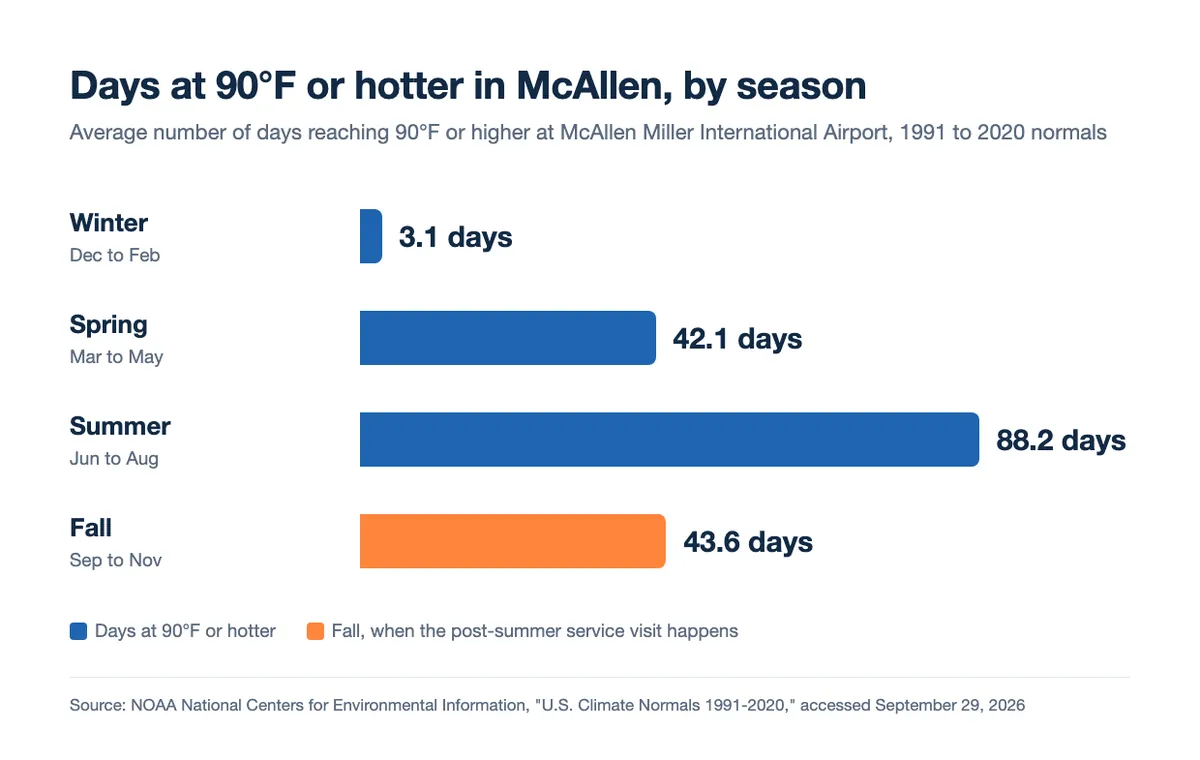
McAllen adds its own reason. NOAA’s climate normals for McAllen Miller International Airport count about 88 days at 90 degrees or hotter from June through August, including about 34 days at 100 or above. The spring visit is the last good chance to get a unit ready before that stretch.
The fall visit matters just as much here, and for a different reason. McAllen still averages about 44 days at 90 degrees or hotter from September through November. A fall visit in the Valley repairs the wear from summer while the unit still has weeks of hard cooling ahead of it.
The four visits, task by task
The tasks and frequencies below come from NREL’s rooftop unit guide. The month windows are a suggested fit for the Valley’s climate, and your contractor may shift them to match your building.
| Visit | Suggested window | Tasks (frequency from NREL Table 1) |
|---|---|---|
| Spring full service | March to April | Quarterly: filters, coils, condensate drain and P-trap. Semiannual: belts, controls and safety interlocks. Annual: compressor, economizer and dampers, ductwork, fans and bearings, refrigerant line leak check. |
| Summer check | June to July | Quarterly: filters, coils, condensate drain and P-trap. |
| Fall full service | September to October | Quarterly: filters, coils, condensate drain and P-trap. Semiannual: belts, controls and safety interlocks. |
| Winter check | December to January | Quarterly: filters, coils, condensate drain and P-trap. Gas burner inspection on gas-heat units. |
Tasks and frequencies: NREL, Rooftop Unit (RTU) Maintenance Guide, September 2025, Table 1, adapted from ANSI/ASHRAE/ACCA Standard 180. Gas burners are listed as a quarterly item; the table shows them in winter as a reminder for heating season.
Two notes on reading the table. The annual tasks sit in spring so the deepest inspection happens right before the hardest months. And the summer check lands in the middle of the Valley’s hottest stretch, when the coil is pulling heat and humidity out of the air all day and every drop of that water depends on a clear drain line.
When is twice a year not enough?
Twice a year is not enough when a building runs its system harder than average, or when the same problems keep coming back. NREL says maintenance should be tailored to your location and to the size and age of the unit, and Standard 180 allows frequencies to be adjusted for climate-related or operational reasons.
Standard 180 also sets a useful rule of thumb. If an inspection finds an unacceptable condition two visits in a row, the owner should investigate the cause instead of fixing the symptom again. A drain pan that is full at every quarterly check is telling you something about the unit, and the schedule should change until the cause is found.
Filters are the clearest example. The quarterly filter change in NREL’s table is a starting point, and NREL’s advice to tailor maintenance to the location and the unit applies here. If the old filter comes out loaded at every visit, the interval is too long for your building.
What does under-servicing a commercial system cost?
Under-servicing a commercial system costs more in energy, repairs and downtime than the maintenance would have. A Pacific Northwest National Laboratory guide written for the U.S. Department of Energy estimates that preventive maintenance saves 12% to 18% compared with running equipment until it fails.
Energy is where the gap shows first, and on a building’s summer electric bill in AEP Texas territory it is hard to miss. NREL cites one study that cut energy use by 20% to 50% through deep maintenance on rooftop units that had drifted out of specification. The timing of failures hurts too: PNNL notes that equipment run to failure tends to break during off hours or near the end of the workday, when getting it back on quickly means paying overtime.
The full cost story, from a seized compressor to a closed dining room, is in Mission Air’s post on what a neglected rooftop unit costs. If your unit has already quit, start with commercial AC repair and build the schedule after.
How do you set up a maintenance schedule for your building?
You set up a maintenance schedule by putting the frequencies, the tasks and the reporting in writing with one contractor. NREL recommends a professional service contract for any building without its own maintenance team, and it lists the questions a good contract should answer:
- Which units are covered, and what tasks are done at each visit?
- How often will each task be performed?
- Are emergency repairs included, on what days and hours, and how fast is the response?
- What report do you get after each visit?
Keep the answers, and keep the visit logs. A written record is what lets you spot the repeat problem that Standard 180 warns about.
Mission Air Conditioning is putting together a commercial maintenance plan built around spring and fall visits. There is no launch date yet. In the meantime, you can call (956) 477-4967 to talk through a schedule for your building, or look over Mission Air Conditioning’s HVAC services and its HVAC maintenance page. Expect a straight answer on what your units need and when, with no pressure to buy more than that.
FAQ
How often should a commercial HVAC system be serviced?
A commercial HVAC system should get two full service visits a year, in spring and fall, plus quarterly checks of filters, coils and condensate drains. That cadence follows NREL’s 2025 rooftop unit guide, which adapts ASHRAE/ACCA Standard 180. Heavy-use buildings may need more.
What is the recommended maintenance schedule for an HVAC system?
The recommended schedule depends on whether the building is a home or a commercial property. ENERGY STAR’s residential guidance centers on a professional cooling check every spring and a monthly filter check. Commercial rooftop units follow a quarterly, semiannual and annual task list under NREL’s guide and Standard 180.
What is an HVAC maintenance checklist?
An HVAC maintenance checklist is a written list of inspection tasks and how often each one is done. For a rooftop unit, NREL’s list runs from quarterly filter and coil checks to annual compressor and refrigerant line inspections. NREL also recommends keeping a detailed log of every task performed, which makes repeat problems easy to spot.
How often should rooftop unit filters be changed?
Rooftop unit filters should be cleaned or replaced at least quarterly, according to NREL’s rooftop unit guide. NREL recommends tailoring maintenance to the location and the unit, so a filter that comes out loaded at every check is a sign the interval should be shorter.
Put your building on a schedule
A commercial HVAC maintenance schedule works when it is written down, followed and logged. If you manage a building in McAllen, Edinburg or Mission, call Mission Air Conditioning at (956) 477-4967 to talk through a spring and fall schedule for your rooftop units, or start with Mission Air Conditioning’s HVAC services.