

The HVAC inspection cost on a McAllen home purchase starts with the general home inspection, because Texas rules already make heating and cooling part of it. The general home inspection has limits worth knowing before you rely on it. McAllen averages about 40 days a year at 100°F or hotter. More than half of McAllen’s housing units (54.7 percent) were built before 2000, so an older house is common in the city.
Mission Air Conditioning works on heating and cooling systems across McAllen, Edinburg, Mission and the rest of the Rio Grande Valley. Once the house is yours, our maintenance visit gives the system a baseline check.
What Does a Texas Home Inspection Check on the AC?
A Texas home inspection checks whether the AC runs, whether it cools within a set range, and whether certain visible parts are damaged. The Texas Real Estate Commission (TREC) sets the minimum in its Standards of Practice for inspectors (22 TAC 535.230). The inspector measures the temperature difference between the air going into the system and the air coming out of the vents. A cooling system that fails to reach a 15°F to 22°F difference gets reported as deficient.
The inspector also has to report these cooling and duct problems:
- Water sitting in the auxiliary (secondary) drain pan.
- Missing or damaged insulation on the refrigerant lines.
- Dirty coils, where they can be reached.
- An outdoor unit without enough clearance, or with damaged fins, poor leveling or too little height above the ground.
- Damaged ducts, missing duct insulation, or no airflow at a supply register.
- Problems with filters, registers and the thermostat.
On the heating side, the inspector reports the type of heat and its energy source. For a heat pump or electric heat, the inspector reports deficiencies in heat pump performance, heating elements and wiring. For a gas furnace, the list covers gas leaks, flame problems and the venting.
What Does a Home Inspector Not Have to Check?
A Texas home inspector does not have to check the refrigerant, confirm the system’s size, or confirm that the indoor and outdoor units match. The inspection rules leave refrigerant, sizing and matched equipment off the required list. Refrigerant, sizing and equipment match each need a separate check if you want an answer on them before closing.
| A Texas inspector must report | A Texas inspector is not required to |
|---|---|
| The temperature split, and a split that fails to reach 15°F to 22°F | Check refrigerant pressure, type or leaks |
| Water in the secondary drain pan | Verify that the indoor coil and outdoor unit match in tonnage and maker |
| Dirty coils, where accessible | Determine the system’s sizing, efficiency or adequacy |
| Damaged ducts and no airflow at supply registers | Check balanced airflow to different parts of the house |
| Gas leaks and venting problems on a gas furnace | Verify the integrity of the furnace heat exchanger |
| Thermostat deficiencies | Verify thermostat accuracy |
The weather can take a test off the list. The inspector is not required to run the cooling when it is below 60°F outside, or a heat pump in heating mode when it is above 70°F. McAllen’s normal lows fall below 60°F in December, January and February. Every month of the year has a normal high above 70°F, even January at 72.8°F. Normal lows are overnight minimums, so a cold morning or a cold front can put the outdoor temperature under 60°F during an inspection. An inspection on a morning below 60°F may leave the AC untested, and an inspection on an afternoon above 70°F may never run the heat pump’s heat.
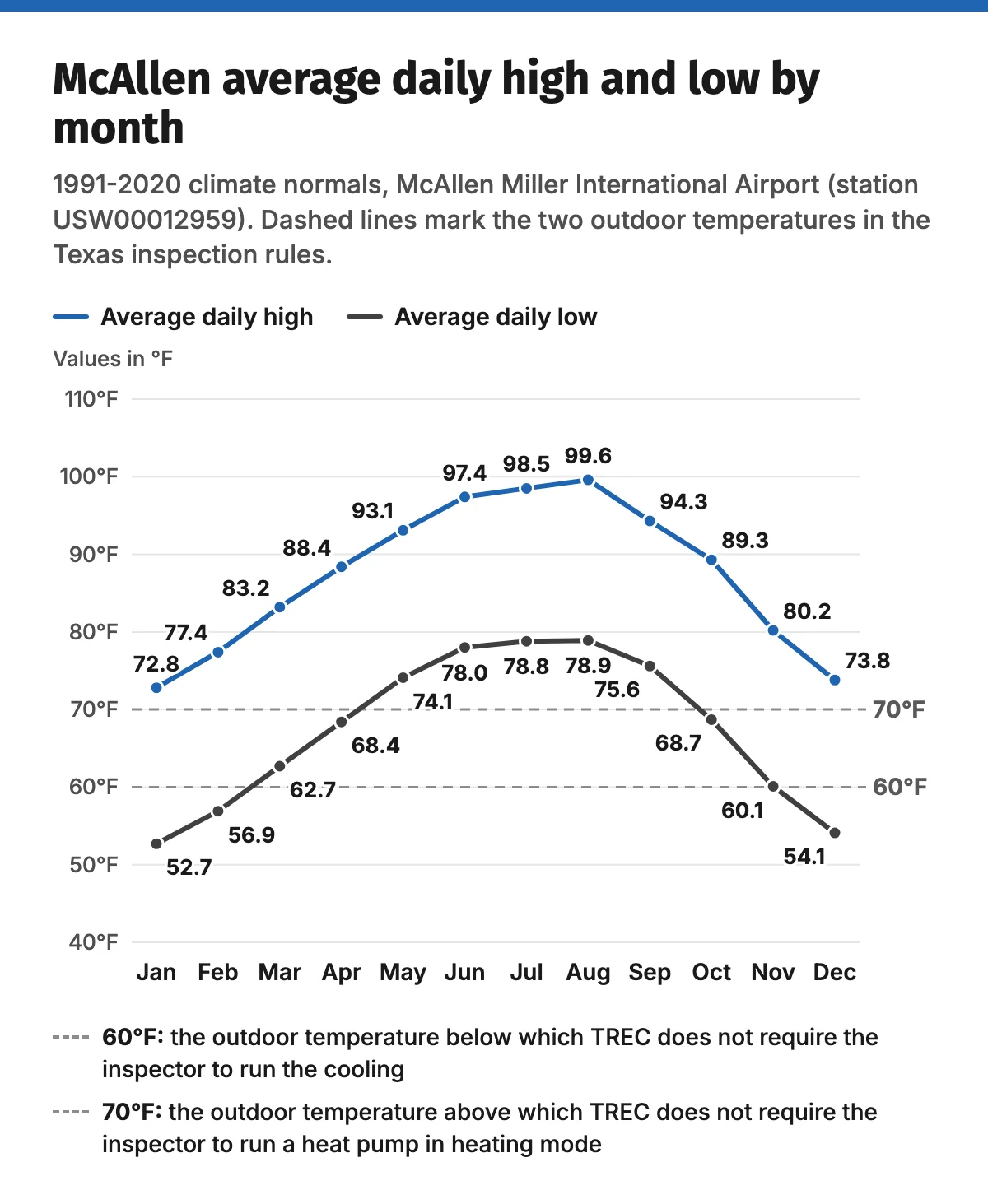
1991-2020 climate normals, McAllen Miller International Airport. Dashed lines mark the two outdoor temperatures in the Texas inspection rules.
Read the inspection report for what was not tested. The inspector also has to report conditions on the day that would affect the temperature reading. If the report says the cooling or heating was not operated, have that system checked next.
What Does an HVAC Inspection Cost Before You Buy?
The HVAC portion of a Texas home inspection comes inside the inspector’s fee, since heating and cooling are part of the standard Texas inspection. The home inspection is something you arrange and pay a qualified inspector for, including on an FHA loan. Ask the inspector for their Standards of Practice or a sample report, so you know what the fee covers.
A deeper look at the AC, covering the items the inspector can skip, is a separate visit priced by whoever does it. Ask for the price and what the visit includes before you book. Compare the separate visit’s cost against the price of the house and the time left in your option period.
How Old Is the AC, and Does It Matter?
The age of the AC matters, and the Texas seller’s disclosure form will not tell you. The disclosure form has the seller mark whether the home has central AC and central heating and whether any listed item has a known defect. The form asks for the roof’s approximate age, and it has no age line for the air conditioner. The disclosure is not a substitute for any inspection, either.
Ask the seller for the install date and the paperwork. Receipts, warranty registration or a service sticker on the unit can answer the age question. Write down the model and serial number from the outdoor unit’s nameplate for the technician.
Check the refrigerant on the nameplate. Federal rules ended new production and imports of R-22, an older refrigerant also called HCFC-22, starting in 2020. A system that still runs on R-22 is worth a hard look before you close. Our checklist on whether to repair or replace an AC in an older RGV home covers R-22 systems and the age question in more detail. For how long Valley systems tend to last, see how long an AC unit lasts in the Rio Grande Valley.
What Warning Signs Can You Spot on a Walk-Through?
You can spot several of the same problems a Texas home inspector reports before you ever make an offer.
Look and listen during your showing:
- Water in the pan under the indoor unit. Water in the secondary drain pan is a reportable deficiency.
- Bare refrigerant lines at the outdoor unit. Missing insulation on the refrigerant lines is a reportable deficiency.
- An outdoor unit crowded by plants or a fence, or sitting off level. Clearance, leveling and bent fins are all on the inspector’s list.
- A shaking or rattling blower. Noticeable vibration of blowers or fans is a reportable deficiency.
- A vent with little or no air. No airflow at a supply register is on the list too.
- A clogged or missing filter. Filter deficiencies are reportable in a Texas home inspection.
Ducts deserve a look, too. A typical house loses about 20 to 30 percent of the air in its duct system to leaks, holes and poor connections. The inspector is not required to check balanced airflow, so a back bedroom that never cools may slip past the report. Our guide to duct sealing in older RGV homes covers the signs.
Which Questions Should You Ask the Seller?
Ask the seller the questions the disclosure form does not cover, and get the answers in writing where you can:
- When was the AC installed, and who installed it?
- When was it last serviced, and is there a receipt?
- Has it needed repairs, and what were they?
- What refrigerant does it use?
- Are any rooms hard to keep cool?
- For a gas furnace: was it serviced before this heating season?
The gas furnace question is a safety question. A fuel-burning furnace should be inspected and serviced before each heating season to protect against carbon monoxide poisoning. The home inspector is not required to verify the integrity of the furnace’s heat exchanger.
When Should You Get the AC Checked?
Get the AC checked during the option period, while you still have the unrestricted right to walk away. Under the TREC resale contract (TREC No. 20-19), the buyer pays an option fee for the right to terminate within a set number of days. If you terminate in time, the option fee stays with the seller and your earnest money comes back to you.
The contract opens the door for the check. The contract lets the buyer have the property inspected by inspectors the buyer selects who are licensed by TREC or otherwise permitted by law to make inspections. The contract also requires the seller to allow access at reasonable times and to keep the utilities on. Accepting the house as is does not stop you from inspecting, negotiating repairs or terminating during the option period.
Time is of the essence. The option deadline is strict: your termination notice is due by 5:00 p.m. local time on the deadline date. Book the AC check in the first days of the option period, so the results arrive with time to act on them.
What to Ask Now, and What to Book After Closing
Before closing, your AC protection comes from two sets of questions, one for the seller and one for the inspector. Ask the seller the questions listed in the seller section, and ask for the service receipts. Ask your home inspector whether the cooling and heating were run, what temperature split the AC showed, and which items on the not-required list were left unchecked.
After closing, book our HVAC maintenance visit so the system starts your ownership with a known condition. Our maintenance visit inspects the system for worn parts and debris, cleans the coils, filters and drains, tests thermostat accuracy and checks refrigerant levels. Thermostat accuracy is an item a home inspector is not required to verify, and the refrigerant charge is part of the refrigerant item the inspector may skip. We work on heat strips, heat pumps and gas furnaces, so the same team can look at the heating side as well.
If the system turns out to be near the end of its life, our replacement assessment looks at the home’s size, layout, insulation and comfort needs before recommending anything, with no upselling. Contact Mission Air Conditioning to book a maintenance visit for your new home, or read what a professional AC tune-up includes.
FAQ
What does an HVAC inspection entail?
An HVAC inspection in a Texas home inspection entails running the system, measuring the temperature difference between supply and return air, and reporting visible defects. The inspector reports problems like water in the secondary drain pan, dirty coils, damaged ducts and gas furnace venting issues. The inspector is not required to check refrigerant, sizing or whether the indoor and outdoor units match.
Will a home inspector test the AC in the winter?
A home inspector in Texas does not have to run the AC when it is below 60°F outside. McAllen’s normal lows drop below 60°F in December, January and February, and normal lows are overnight minimums, so a cold morning or a cold front can put the outdoor temperature under 60°F. If your report says the cooling was not operated, ask your inspector about it before your option period ends.
Can I back out of buying a house in Texas because of AC problems?
You can back out for any reason during the option period under the standard Texas resale contract, including AC problems, as long as the contract has an option period and you paid the option fee on time. The buyer gives notice of termination within the option period, the option fee stays with the seller, and the earnest money is refunded. After the option period ends, the unrestricted right to terminate is gone.
Does an FHA appraisal check the air conditioning?
An FHA appraisal is not the step to rely on for the air conditioning’s condition, so arrange a home inspection and an AC check yourself. An appraisal estimates the home’s value for the lender and does not replace a home inspection.
How often should an HVAC unit be serviced?
An HVAC system should get a yearly inspection, with regular filter changes in between. A fuel-burning furnace should also be serviced before each heating season to guard against carbon monoxide. Ask the seller when the last service happened, and ask for the receipt.