

Your AC passed its last tune-up. The air at the vent feels cold. And still the back bedroom never cools down, the house feels dusty, and the electric bill keeps climbing. In a lot of older McAllen homes, the problem sits between the unit and the rooms: in the ducts.
More than half of McAllen’s housing units (54.7 percent) were built before 2000, according to U.S. Census Bureau data. When a home’s ductwork runs through the attic, joints can loosen and old tape can give up over the years. The air your system paid to cool then leaks into the attic before it ever reaches a vent.
This guide covers what duct sealing costs, how to tell whether your ducts leak, what the job involves, and what you can fix yourself. Before you pay anyone to seal anything, have Mission Air Conditioning look at the whole system. A tune-up or diagnostic visit tells you whether the equipment is healthy, so you know whether the ducts are the real suspect before you spend money on them.
How Much Does Duct Sealing Cost?
Professional duct sealing costs about $500 to $4,000 nationally, with an average near $2,250, according to Angi’s 2026 cost data. The same data puts the typical rate at $0.50 to $1.50 per square foot of home. These are national averages, so use them as a starting point and ask for a local quote.
What moves the price most is how much ductwork you have, how easy it is to reach, and how bad the leaks are. Ducts that run through a tight attic cost more to seal than ducts you can reach standing up.
| Home size | Typical duct sealing cost (national, 2026) |
|---|---|
| 1,000 sq ft | $500 to $1,500 |
| 1,500 sq ft | $750 to $2,250 |
| 2,000 sq ft | $1,000 to $3,000 |
| 2,500 sq ft | $1,250 to $3,750 |
| Line item | Typical cost (national, 2026) |
|---|---|
| Duct inspection | About $150 |
| Pressure test (before or after sealing) | $200 to $450 |
| Aerosol sealing, average | About $1,300 |
| Manual sealing with mastic, average | About $2,250 |
| Duct repair before sealing, average | About $660 |
| New ductwork, for comparison | $3,000 to $7,500 per 300 linear feet |
Source: Angi 2026 cost guides for duct sealing and AC replacement.
Aerosol sealing costs less, but it cannot patch large holes. It works from the inside and handles small leaks. A disconnected duct or a torn run still needs hands and mastic.
AEP Texas may offset part of the cost. AEP Texas lists “A/C System Duct Testing and Sealing” as an eligible measure in its Residential Standard Offer Program. The incentive goes to the participating contractor, and program funding is limited, so ask any contractor whether they take part before you book.
Why Do Older RGV Homes Lose So Much Air Through Their Ducts?
Older RGV homes were never required to prove their ducts were tight. Texas made duct leakage testing mandatory for new single-family homes on September 1, 2016, under the 2015 energy code, with a limit of 4 cubic feet per minute per 100 square feet of floor area. The 2009 code before it allowed three times that. A house built in the 1980s or 1990s was held to neither.
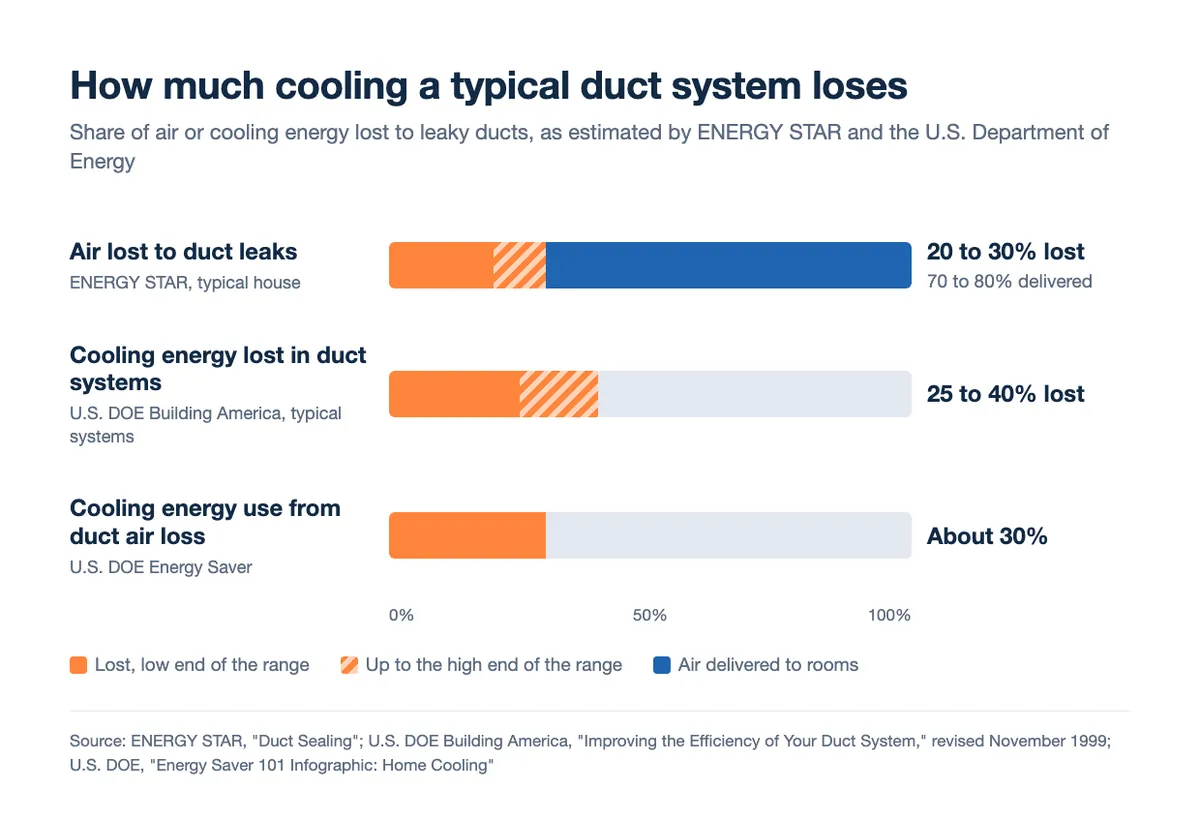
Leakage is common even in average homes. ENERGY STAR estimates that about 20 to 30 percent of the air moving through a typical duct system is lost to leaks, holes, and poorly connected ducts. A U.S. Department of Energy guide puts typical duct losses at 25 to 40 percent of the cooling energy the equipment produces, and notes that attic ducts in hot, humid climates often lose more.
McAllen is that climate. NOAA’s 1991-2020 normals for McAllen show about 40 days a year at 100°F or hotter and about 177 days at 90°F or hotter. Every one of those afternoons, cooled air runs through ducts sitting in the hottest part of the house.
Duct tape is part of the story. The DOE guide notes that duct tape on joints often loses its grip after a few years, and you can sometimes see it hanging off. If your older system was taped rather than sealed with mastic, those joints are the first suspects.
How Can You Tell If Your Ducts Are Leaking?
The clearest sign is a healthy AC that still cannot keep certain rooms comfortable. ENERGY STAR and DOE list a handful of symptoms:
- Rooms that never cool down. ENERGY STAR lists rooms that are hard to cool as a classic duct symptom.
- High bills for the size of your home. ENERGY STAR lists high utility bills as a leading sign.
- Stuffy rooms that never feel right. Air is moving, but it misses the rooms you use.
- A dusty house. Leaky return ducts can pull in dust from the attic and push it through the vents.
- Ducts in the attic or garage. ENERGY STAR flags these locations, since a leak there sends cooled air into space you never meant to cool.
- Tangled, kinked, or crushed flex duct. ENERGY STAR notes that kinks restrict airflow, leak or no leak.
- Tape peeling off the joints. Old duct tape that you can pull away by hand is not holding a seal.
- Dark streaks on duct insulation. DOE notes that dust collecting on insulation over a loose joint is a sign that air is being pulled through it.
One caution: several of these signs also point to a failing unit, a clogged filter, or low refrigerant. That is why a system check should come first.
What Happens During a Professional Duct Sealing Job?
A good duct sealing job starts with finding the leaks and ends with proving they are closed. ENERGY STAR’s checklist for hiring a contractor is a useful yardstick. A thorough job should:
- Inspect the whole duct system, including the attic.
- Check the balance between supply and return air. Many systems have return ducts that are too small.
- Reconnect loose ducts and straighten crushed or tangled flex duct.
- Seal leaks and connections with mastic, metal tape, or an aerosol-based sealant.
- Seal each register and grille tightly to its duct.
- Insulate ducts in unconditioned spaces, like the attic, to R-6 or higher.
- Put in a new filter and check airflow once the work is done.
Many contractors offer a pressure test before and after, so you can see the leakage number drop. Angi’s national data prices a test at $200 to $450.
Ask whether the quote includes the test. A before-and-after pressure test is the only way to know how much leakage you paid to remove.
What Can You Seal Yourself?
You can seal the leaks you can see and reach, as long as you use the right materials. ENERGY STAR describes a do-it-yourself approach for the ducts you can reach in an attic or garage:
- Look for obvious holes, gaps, and disconnected sections.
- Check where registers meet the ceiling or wall. DOE notes that the hole cut for a register boot is often too large and leaks around the edges.
- Seal accessible gaps with duct mastic or metal-backed foil tape.
- Never use gray cloth duct tape. ENERGY STAR says plainly that it does not last.
- Wrap ducts that run through the attic with duct insulation.
DOE’s field guide for crews matches the fix to the gap. Seams under 1/4 inch get fiberglass mesh tape and a coat of mastic. Gaps from 1/4 to 3/4 inch need a backer tape first, then mastic and mesh. Holes larger than 3/4 inch need a real patch held with mechanical fasteners before any mastic goes on.
Where DIY stops. Ducts inside walls and ceilings are hard to reach, and leaks are hard to find without a pressure test. Labor is about 90 percent of the cost of a manual sealing job, per Angi’s national data, so doing the reachable work yourself can save real money. ENERGY STAR still recommends a professional check afterward to confirm the system is balanced.
Pick your hour. An RGV attic in summer is no place for a long project. If you go up there, go early in the morning, bring water, and step only on the framing.
How Much Can Sealing Save on Your Electric Bill?
Sealing can recover a meaningful share of what your AC spends on cooling. ENERGY STAR says leaky ducts can cut a heating and cooling system’s efficiency by as much as 20 percent. DOE estimates that air lost through ducts accounts for about 30 percent of a cooling system’s energy use.
ENERGY STAR adds that sealing and insulating ducts can often pay for itself in energy savings. How fast depends on how leaky your system is and where the ducts run. A home with loose attic ducts has the most to gain.
The comfort payoff shows up first. ENERGY STAR notes that sealed ducts help with rooms that run too hot in summer, and DOE’s consumer guide says sealing with mesh and mastic can help control humidity and dust. In a house that still feels sticky with the AC running, that matters as much as the bill.
Sealing now can shape your next system. ENERGY STAR notes that a sealed duct system may let you choose a smaller, less costly unit that removes humidity better. If a replacement is a few years out, tight ducts first can mean a better-sized system later.
Ducts are one piece of the efficiency picture. For the rest, see other ways to keep your AC efficient through an RGV summer. If your attic runs extremely hot, how attic insulation affects your AC bill covers the heat coming through the roof.
Where Should You Start?
Start with the equipment, then the ducts. A leaky duct system and a struggling AC unit can produce the same warm bedroom and the same high bill. Paying for duct sealing will not help if the real problem is a dirty coil or a failing part.
Mission Air Conditioning’s maintenance visit inspects the system, cleans the coils, filters, and drains to keep air moving, and tests the thermostat and refrigerant levels. That tells you whether the unit is healthy. If it is, and the symptoms above still fit, you can look at your ducts with confidence.
If your system is near the end of its life, Mission Air’s replacement assessment looks at your home’s size, layout, and insulation before recommending anything, with no upselling. Duct condition is worth raising in that conversation.
No ducts at all? Some older homes were built without them. Read about ductless options for older McAllen homes instead.
Not sure where your cooled air is going? Contact Mission Air Conditioning or explore Mission Air’s HVAC services to book a system check. You will get a plain answer on whether your unit is doing its job, before you spend a dollar on the ducts.
FAQ
Is duct sealing worth the cost?
Duct sealing is usually worth it in homes with attic ducts and clear symptoms like warm rooms and high bills. ENERGY STAR says leaky ducts can reduce system efficiency by as much as 20 percent, and that sealing and insulating ducts can often pay for itself in energy savings.
How much does it cost to seal your ductwork?
Professional duct sealing typically costs $500 to $4,000, with an average around $2,250, according to Angi’s 2026 national data. A 1,500-square-foot home typically falls between $750 and $2,250.
How long does duct sealing last?
Duct sealing lasts far longer with mastic or foil tape than with cloth duct tape. DOE notes that duct tape often loses its grip after a few years, which is why ENERGY STAR recommends mastic or metal-backed tape instead.
Can I seal my own ductwork?
You can seal the ducts you can see and reach, such as attic runs and register edges, with mastic or foil tape. ENERGY STAR recommends having a professional check the system’s balance afterward, since hidden leaks are hard to find without a pressure test.
What do HVAC techs use to seal ductwork?
HVAC technicians seal ducts with mastic, metal tape, or an aerosol-based sealant, according to ENERGY STAR. For larger gaps, DOE’s field guide calls for fiberglass mesh or a fastened patch under the mastic.