

You booked the tune-up, a tech spent an hour at your house, and you got an invoice. What a lot of McAllen homeowners don’t get is a clear account of what was done, or why a couple of items came back with a second price attached. That gap is where the question “is this even worth paying for?” comes from.
This guide closes it. It covers what a real AC tune-up includes, where the tune-up ends and a repair quote begins, and how to tell a fair recommendation from an upsell. Mission Air Conditioning runs tune-ups across McAllen, Edinburg, Mission and the rest of the Rio Grande Valley as part of its HVAC services, and the way Mission Air handles HVAC maintenance follows the same order you’ll read below: inspect and test, clean, then tell you what was found.
What does an AC tune-up include?
An AC tune-up includes cleaning, testing and adjusting the parts of your system that drift out of spec over a cooling season: the coils, the refrigerant charge, the electrical parts, the drain line, the blower, the filter and the thermostat. ENERGY STAR’s maintenance checklist for central air names those same core tasks. The Air Conditioning Contractors of America (ACCA) goes a step further with ANSI/ACCA 4 QM, a manufacturer-endorsed standard that sets the minimum tasks for a residential maintenance inspection.
Here is what each task looks like when the tech is standing at your unit.
| Task | What the tech does | Why it matters in the RGV |
|---|---|---|
| Outdoor (condenser) coil | Inspects the coil and rinses off dirt and debris | The outdoor coil has to shed your home’s heat into August afternoons that average 99.6°F in McAllen |
| Indoor (evaporator) coil | Inspects the coil and cleans it when it needs it | This coil pulls heat and moisture out of your air, so buildup cuts into both |
| Refrigerant | Reads the system pressures and checks the charge against the manufacturer’s spec | A charge that is off in either direction costs cooling and efficiency |
| Electrical connections | Tightens connections and measures voltage and current on the motors | Loose connections make motors work harder |
| Capacitor | Measures it with a meter and compares the reading to the rating on its label | Heat shortens capacitor life, and a weak one can stop the unit from starting |
| Condensate drain | Checks the line and clears it | In RGV humidity the indoor coil pulls a steady stream of water out of your air, and it has to drain somewhere |
| Blower | Cleans and adjusts blower parts | Airflow problems alone can cut efficiency by up to 15% |
| Filter | Checks it and replaces it or tells you it’s due | A clogged filter chokes airflow between visits |
| Thermostat and controls | Checks the reading and confirms the system starts, runs and shuts off properly | A misreading thermostat runs the system longer than it needs to |
If you want a line-by-line list to hold while the tech works, the HVAC tune-up checklist for McAllen homeowners walks through each item from the homeowner’s side. This post stays on the other side of the unit: what the tech is doing, and what counts as extra.
How does Mission Air run a tune-up?
Mission Air Conditioning runs a tune-up in three stages, which its maintenance page calls inspect and test, clean and optimize, and tune and advise. In practice, the cleaning and testing overlap across the first two.
- First, the tech looks over the whole system for worn parts, debris, and anything else affecting performance, and cleans the coils, filters and drains that keep air moving.
- Next, the tech tests the system’s functions, the thermostat’s accuracy and the refrigerant level, then makes fine adjustments.
- Last, the tech tightens electrical connections, lubricates moving parts, and points out small problems before they turn into repairs.
Every company draws the edges of that scope a little differently, so before the visit, ask what yours includes. A tune-up has a defined scope, and work outside it should come to you as a separate price you can say yes or no to.
Where does the tune-up end and a repair begin?
The tune-up ends where a finding needs a new part, added refrigerant, or labor well beyond cleaning and testing. That work is a repair, and a fair company quotes it before doing it. ACCA’s standard is built around that split: the minimum tasks come first, so homeowners have a baseline to compare the value of any additional corrective work the tech recommends.
| Included in the tune-up | Quoted separately, only when a reading calls for it |
|---|---|
| Checking the refrigerant charge | Finding and fixing a leak, then adding refrigerant |
| Inspecting the coils and cleaning them as part of the visit | Coil cleaning beyond what the visit covers, such as a heavily soiled indoor coil |
| Testing the capacitor | Replacing a capacitor that reads outside its tolerance |
| Clearing the condensate drain | Replacing damaged drain parts |
| Looking over visible ductwork | Duct cleaning, which EPA advises only for mold, pests or heavy debris |
Three of those rows cause most of the confusion.
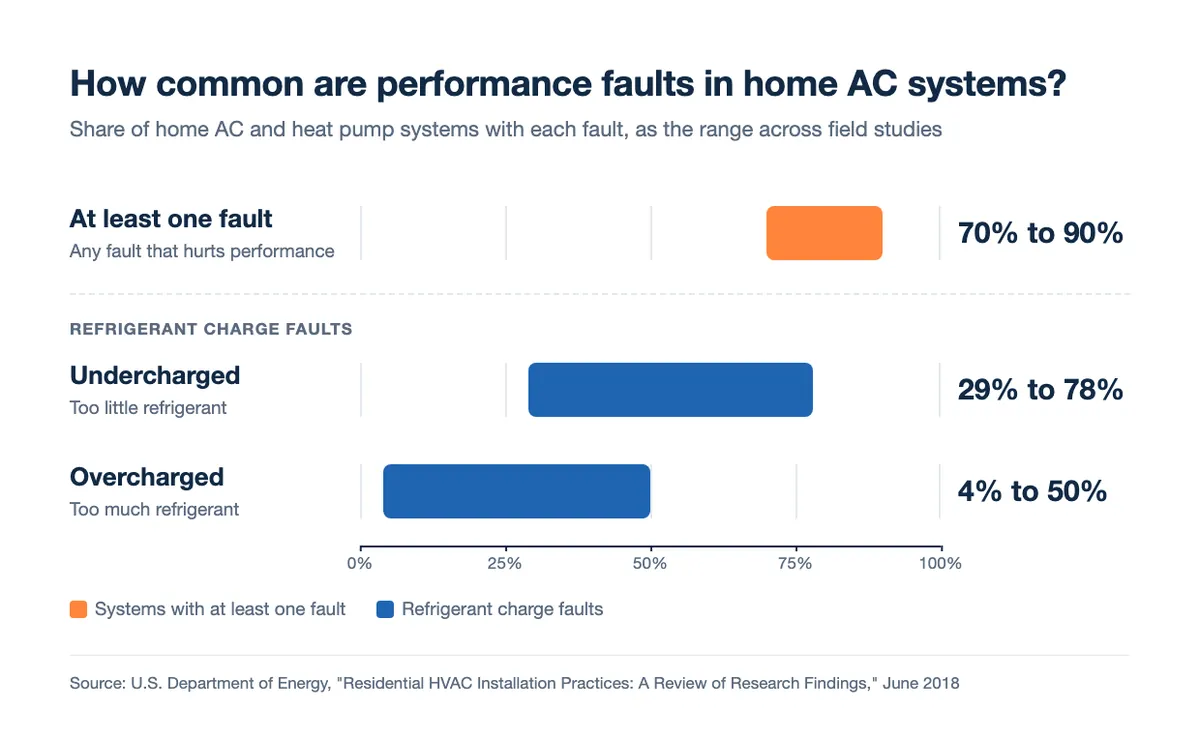
Refrigerant gets checked; topping it off is a separate call. Bryant, the equipment manufacturer, says refrigerant should not be added on a yearly schedule, and a system with the wrong charge needs a diagnosis first. The EPA tells homeowners to ask technicians to find and repair leaks instead of topping off a leaking system. More refrigerant isn’t automatically the fix, either: a Department of Energy review of field studies found overcharged systems as well as undercharged ones, and it calls for checking charge with the manufacturer’s method (superheat or subcooling). If your system is older and runs on R-22, no new R-22 has been made or imported in the U.S. since January 1, 2020. You can keep running that system, but a leak that keeps coming back is a good reason to ask whether it’s time to replace your AC, not just repair it.
Coil cleaning comes in two sizes. Bryant notes there is no universal schedule for coil cleaning; a tech inspects the coils and cleans them when they need it. A routine cleaning fits inside the visit. A heavily soiled indoor coil can take much more work than that, and some companies quote it separately, so ask where your company draws that line before the tech starts. Between visits, you can handle some of the outdoor side yourself by cleaning your condenser coils.
A capacitor recommendation should come with a number. Carrier explains that a technician measures a capacitor in microfarads and compares it to the manufacturer’s tolerance, usually within 5 or 6 percent of the rating printed on the part. Carrier also notes that heat and vibration wear these parts down, which matters in a South Texas summer. If the tech says yours is weak, ask what it read and what the label says it should read.
How can you tell a fair recommendation from an upsell?
A fair recommendation comes with a reading you can check. An upsell usually shows up with urgency and no number attached.
Keep one thing in mind before you get suspicious of every finding: problems are common. The same DOE review found that 70 to 90 percent of home AC and heat pump systems have at least one fault that hurts performance, from the original installation or from missed maintenance. A tech who finds something may simply be doing the job.
These questions sort the two quickly:
- What did it read, and what should it read? Capacitor ratings, refrigerant pressures and voltage all have a spec. A real finding has a gap between the two.
- Can you show me? A photo of the meter, the part label, or the clogged line takes a minute.
- What happens if I wait until the next visit? Some findings can wait a season. A tech should be able to tell you which ones can’t.
- Is this a repair, or an add-on? Duct cleaning is the classic add-on. The EPA does not recommend routine duct cleaning and says it has never been shown to prevent health problems; it’s worth doing when there’s visible mold, pests or heavy debris.
- Who is handling the refrigerant? Anyone who services refrigerant equipment has to hold EPA Section 608 certification, and it’s fair to ask.
Many contractors hand over a written summary of what they inspected and found, so ask for one. Mission Air’s standard is clear, upfront pricing with no hidden fees or surprise charges, so you can make an informed decision.
Why does a full tune-up matter more in McAllen?
A full tune-up matters more here because the small drifts it corrects run for more hours, in more heat, than in most of the country. McAllen’s normal high is 97.4°F in June, 98.5°F in July and 99.6°F in August. Nationally, air conditioning accounts for about 19% of the electricity used in U.S. homes, and McAllen’s long, hot summers put that load on your electric bill month after month.
That’s why a skimmed visit costs more here. A slightly low charge, a coated coil or a restricted blower each makes the compressor run longer to do the same work, and airflow problems alone can cost up to 15% in efficiency. Across a long RGV cooling season, that adds up on every bill. If you’re weighing whether the visit is worth it at all, what happens when you skip a tune-up lays out the other side.
Is an AC tune-up worth paying for?
A full AC tune-up is worth paying for, because it’s the easiest point to catch a weak capacitor, a slow leak or a clogged drain before one of them shuts your system down on a 100-degree afternoon. The value depends on the scope, which is why knowing what’s included matters more than the price on the coupon.
If you’d rather not track it yourself, the Mission Care Plan from Mission Air Conditioning builds two tune-ups a year into a membership, along with priority service, 10% off repairs, no service or dispatch fees Monday through Friday from 8am to 5pm, and a $500 loyalty reward toward a new system when it’s time to replace. For the math on whether a plan beats paying per visit, see whether a maintenance plan is worth it.
FAQ
Do you really need an AC tune-up?
In the Rio Grande Valley, yes, because your system runs through months of near-100-degree highs, and the tune-up is where a technician catches worn parts before the heat does. Filter changes and clearing debris from the outdoor unit are yours to handle; refrigerant, electrical testing and the capacitor need a technician with the right tools.
How much should a full AC tune-up cost?
This Old House puts the typical cost of an AC tune-up at $65 to $200 in 2026, depending on the system and the contractor. Compare what each company includes before you compare prices, since a low price for a short list of tasks is a different service from a full tune-up. Ask Mission Air for its current tune-up price when you call.
How long does an AC tune-up usually take?
A full AC tune-up usually takes about an hour to an hour and a half: Bryant puts most visits at 60 to 90 minutes, and Carrier allows up to two hours. A system in rough shape or one that needs a repair will take longer.
Does an AC tune-up include refrigerant?
An AC tune-up includes checking the refrigerant charge, but adding refrigerant is a separate repair. If the charge is low, the EPA advises having the leak found and fixed instead of topping off the system.
Can I do my own AC tune-up?
You can do part of it yourself: change or check the filter monthly, as ENERGY STAR recommends, and keep the outdoor unit clear. Checking the refrigerant charge and testing electrical parts require a trained technician, and anyone handling refrigerant must hold EPA Section 608 certification.
Book a Tune-Up That Shows Its Work
A tune-up should leave you knowing what was cleaned, what was tested, what it read, and what, if anything, needs a separate decision. That is the visit Mission Air Conditioning runs for homeowners in McAllen, Edinburg, Mission and across the RGV. Book one through HVAC maintenance, ask about the Mission Care Plan, or contact Mission Air with any questions about your system.