

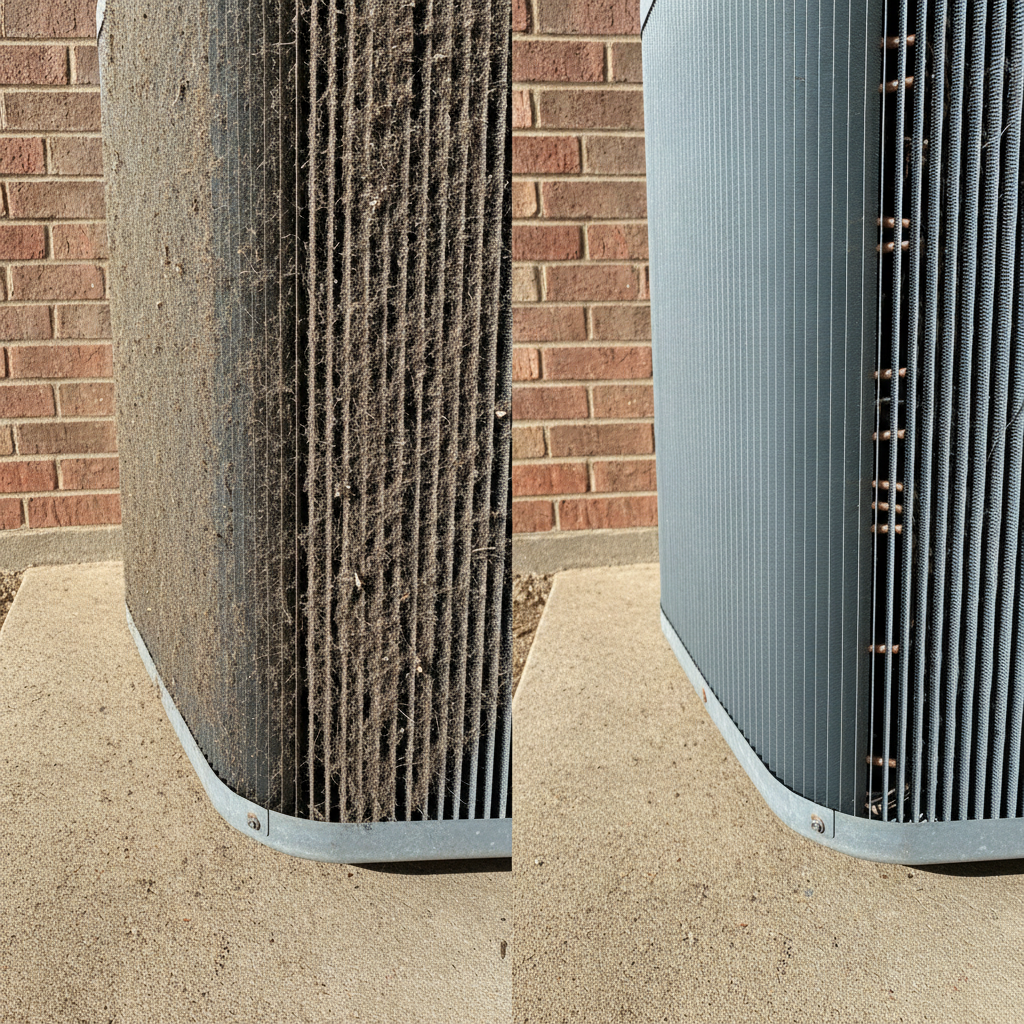
Your outdoor AC unit, the metal box sitting in your backyard or on the side of your house, is called the condenser. Its job is to release the heat your AC pulls from inside your home out into the outdoor air. To do that efficiently, it needs airflow through its aluminum fins.
When those fins get coated in dust, cottonwood, grass clippings, and debris (all very common in the RGV), the condenser can’t reject heat efficiently. Your AC runs longer, works harder, and uses more electricity. Dirty condenser coils are one of the more common and fixable causes of high AEP Texas bills in South Texas.
The good news: basic condenser cleaning is something most homeowners can do themselves with a garden hose and 20 minutes.
What You’ll Need
- Garden hose with a spray nozzle (adjustable to a gentle spray)
- Soft brush or fin comb (optional, for dislodging stuck debris)
- Screwdriver (to remove the top panel if needed)
- Coil cleaner spray (optional, available at hardware stores)
- Gloves
You do NOT need a pressure washer. Condenser fins are made of thin aluminum that bends easily under high pressure. A garden hose with gentle pressure is the right tool.
Step 1: Shut Off Power to the Unit
Before touching anything, cut power to the outdoor unit. There are two ways to do this:
- Disconnect box: There’s typically a metal disconnect box mounted on the exterior wall near the outdoor unit. Inside is a pull-out block or a breaker. Pull out the block or flip the breaker to cut power to the condenser.
- Breaker panel: Alternatively, go to your electrical panel and flip the breaker labeled for the AC condenser (not the air handler, you want the outdoor unit specifically).
Once power is cut, wait a few minutes before touching the unit. Capacitors inside can hold a charge briefly after power is disconnected.
Step 2: Remove Debris From Around and On Top of the Unit
Clear any leaves, grass clippings, cottonwood fluff, or debris sitting on top of the condenser and around its base. The unit pulls air in through the sides and exhausts it up through the top, blockages on top directly reduce airflow.
If landscaping has grown close to the unit, this is a good time to trim it back. You want at least 18 to 24 inches of clear space on all sides.
Step 3: Rinse the Fins From the Inside Out
The condenser fins are the thin aluminum slats that surround the unit. Debris accumulates on the outside of the fins, building up a layer that blocks airflow.
The right way to clean them: spray from the inside out. Take your garden hose (on a gentle spray setting, not jet), direct the water through the top of the unit toward the fins, and let the water pressure push debris outward. This is more effective than spraying from the outside in, which pushes debris deeper into the fins rather than clearing it.
If your condenser unit allows access to the interior coil (some units have a removable top grille), this is easiest to do from above. Otherwise, you can rinse from outside the unit, just use lower pressure and multiple passes.
Step 4: Apply Coil Cleaner (Optional)
If the fins have a lot of built-up grime that water alone isn’t clearing, a foam coil cleaner can help. Available at most hardware stores and HVAC supply shops, these foaming cleaners are sprayed on, allowed to dwell for a few minutes, and then rinsed off. Follow the product directions, most are self-rinsing.
Coil cleaner isn’t necessary every time. For regular seasonal maintenance, a good rinse is usually enough. Use coil cleaner if the fins look heavily caked or if you’ve never cleaned the unit and it’s been running for a few years.
Step 5: Straighten Bent Fins (If Needed)
Over time, condenser fins can get bent or crushed, which reduces airflow through the coil. A fin comb (a plastic tool with different tooth spacings for different fin densities) can straighten bent sections. This isn’t a critical step unless you can see clearly bent fins, but it does help airflow if significant sections are damaged.
Step 6: Restore Power and Run the System
Once you’ve rinsed the unit and let it dry for a few minutes, restore power at the disconnect box. Then set your thermostat to cool and let the system run. A clean condenser coil should allow the system to reach your set temperature faster and run shorter cycles.
How Often to Clean the Condenser Coils in South Texas
In the RGV, condenser cleaning once a year is the minimum, ideally in early spring before peak cooling season starts. If you’re near construction, cotton fields during boll-drop season, or significant landscaping, you may benefit from cleaning twice a year.
A yearly professional tune-up will include condenser coil cleaning as part of the service, so if you’re getting an annual tune-up, you may not need to do the DIY cleaning separately. Read about what a professional AC tune-up covers to see what’s included.
When to Call a Professional Instead
DIY condenser cleaning is appropriate for exterior coil surfaces. Call a professional if:
- The indoor evaporator coil (inside the air handler) needs cleaning, this requires refrigerant-safe tools and access to the air handler interior
- You see ice on the coil or refrigerant lines
- The fins are badly damaged or bent across a large area
- The system isn’t improving after a clean coil, you may have a refrigerant issue or a failing component
For general AC maintenance best practices in the RGV, read keeping your AC running efficiently all summer and how often to change your AC filter in South Texas. Both are quick reads that cover the basics homeowners in McAllen should be doing.
Frequently Asked Questions
Can dirty condenser coils damage my AC system?
Yes, over time. When the coil can’t reject heat efficiently, the compressor runs under higher head pressure, which stresses it and shortens its lifespan. You probably won’t notice it happen, but years of running with dirty coils contribute to premature compressor failure.
How do I know if my condenser coil is dirty?
Look at it. If you see a visible layer of dust, cottonwood, grass, or debris coating the fins, they need cleaning. A light dusting is normal; a grey felt-like layer coating the fins means it’s time. You can also check system performance: if your AC is running longer than usual and your energy bills are up, a dirty coil is one of the first things to check.
Can I use a pressure washer to clean the condenser?
No. Pressure washers can easily bend aluminum fins, and damaged fins restrict airflow permanently. A garden hose on a gentle or moderate spray setting is the right tool.
Is condenser cleaning the same as an AC tune-up?
No. Condenser coil cleaning is one part of what an AC tune-up covers. A full professional tune-up also includes refrigerant pressure check, electrical connections inspection, capacitor testing, thermostat calibration, drain line check, and other items. Both are worth doing.
Need Professional Coil Cleaning?
Mission Air Conditioning provides HVAC maintenance services in McAllen and the Rio Grande Valley, including condenser coil cleaning, full tune-ups, and refrigerant checks. If you’d like a professional to handle the full maintenance cycle before the hottest stretch of summer, schedule at missionaircon.com.