

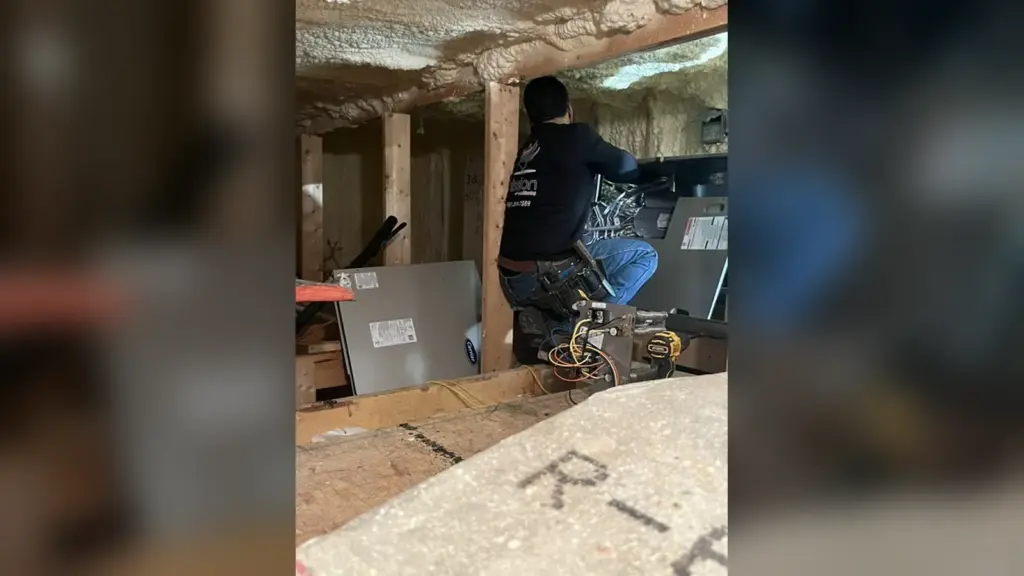
In the Rio Grande Valley, the long-term weather station in Brownsville averages 90 percent relative humidity at 6 a.m., and hurricane season runs until the end of November. So when you look at spray foam insulation, humidity and storms belong in the decision alongside the energy bill. For a homeowner in McAllen or Edinburg, the bigger question is what the foam does with water: humid air, a roof leak, or a storm that drops a foot of rain.
Spray foam blocks air leaks far better than fiberglass or cellulose, according to a DOE guide, but open-cell and closed-cell foam handle water very differently, and neither one turns a house into a storm shelter. This guide sticks to what federal and building-science sources say about both.
Mission Air Conditioning installs spray foam insulation in McAllen and the Valley, and it also services the air conditioning that keeps a sealed house dry. One company can look at both sides of the moisture question in your home.
How Does Spray Foam Insulation Handle Humidity?
Spray foam insulation handles humidity first by stopping humid outdoor air from leaking into the house. A Department of Energy Building America guide rates both open-cell and closed-cell foam as excellent at air sealing, because the expanding foam fills the gaps, cracks, and voids where outside air gets in.
Outside air in the RGV carries a lot of water. NOAA’s period-of-record mean dew point at Brownsville runs about 76°F in summer, and DOE’s climate map puts Hidalgo County in the hot-humid zone. The DOE guide notes that in hot-humid climates, moisture pushes through the walls and roof from the outside in.
After air sealing, the two foams part ways on water vapor and liquid water.
Open-cell foam lets vapor through. The DOE guide rates open-cell foam at 5 to 10 perms at a typical 5-inch thickness, while a vapor retarder by definition is 1 perm or less. Open-cell foam can also absorb and hold liquid water, up to one-third of its volume depending on the product.
Closed-cell foam acts as a vapor retarder. At about 2 inches thick, closed-cell foam tests under 1 perm, and the DOE guide calls it hydrophobic, meaning it won’t absorb water.
| Moisture and storm property | Open-cell spray foam | Closed-cell spray foam |
|---|---|---|
| Air sealing (DOE guide) | Excellent | Excellent |
| Water vapor (DOE guide) | 5 to 10 perms at 5 inches; lets vapor pass | Under 1 perm at 2 inches; a vapor retarder |
| Liquid water (DOE guide) | Can hold up to one-third of its volume | Hydrophobic; will not absorb water |
| FEMA flood rating (TB-2, 2025) | Unacceptable below flood elevation | Acceptable |
| On a hot-humid roof deck (DOE guide) | Acceptable | Preferred |
The table covers moisture only. For R-value, cost, and where each type usually goes, read open cell vs. closed cell spray foam for South Texas homes.
Open cell has a place in hot-humid homes too. The DOE guide rates open-cell foam “acceptable” on hot-humid roof decks as long as no vapor retarder is added to its interior side, and it rates closed-cell foam “preferred” in all climates. The right choice depends on where the foam goes and how the rest of the house handles water, which is why Mission Air’s spray foam process starts with an inspection and a choice of foam type for your specific home.
Can Spray Foam Cause Mold or Humidity Problems?
Spray foam itself doesn’t create moisture, but two situations after an install can lead to mold or humidity problems in RGV homes.
A sealed house leans harder on the AC. In a hot-humid climate, the DOE guide says a conditioned home depends on its air conditioning to remove excess indoor moisture. The same guide warns that HVAC systems in these climates may not run enough to dehumidify well during the shoulder months, the milder stretches of spring and fall. The EPA recommends keeping indoor humidity below 60 percent, and it says a home that stays above 60 percent with the AC in use needs a specific dehumidification strategy.
A roof leak can hide under closed-cell foam. The DOE guide says water from a roof leak will not soak into closed-cell foam, so the leak “may not be immediately apparent.” With a worn roof, that makes a leak harder to find. Open-cell foam works the other way: a leak wets it, and the guide says it will dry given time and dry conditions.
The EPA’s mold rule applies either way: wet materials dried within 24 to 48 hours usually don’t grow mold. Mold risk after spray foam comes from two places, a leak nobody sees and a house whose AC can’t keep up with the humidity, and both can be checked.
What Spray Foam Can and Cannot Do in a Storm
In a storm, closed-cell spray foam can add strength to a roof deck and hold up to floodwater, but no insulation makes a home hurricane-proof.
The Valley has seen what a storm does to houses here. Hurricane Hanna came ashore on Padre Island in July 2020 with 90 mph sustained winds, and a rain gauge near McAllen collected 12.66 inches. NWS Brownsville reported 18 inches to 4 feet of water in areas east of Edinburg and around Mission, at least 250,000 Valley customers without power, and hundreds of poorly built homes damaged, mainly their roofs. The Atlantic hurricane season officially runs from June 1 to November 30.
Roof deck strength. The DOE guide cites studies at the University of Florida and elsewhere that documented a structural advantage from using closed-cell foam to glue roof decking to trusses in hurricane-prone areas. The guide says roof-deck closed-cell foam enhances wind-storm resistance. The DOE guide presents that as an added advantage and does not describe spray foam as a substitute for the roof structure itself.
Water after a roof failure. The DOE guide notes that in a catastrophic roofing failure, like one that can happen in a hurricane, the fact that water will not penetrate closed-cell foam can be a benefit.
Flooding. FEMA’s Technical Bulletin 2, in its January 2025 edition, rates closed-cell foam insulation as an acceptable flood damage-resistant material. FEMA defines that as a material that can take direct contact with floodwater for at least 72 hours without significant damage. The same FEMA table rates open-cell foam, fiberglass, and cellulose as unacceptable. FEMA’s ratings apply to materials used below the base flood elevation in mapped flood zones, and the rating describes how the material itself holds up in floodwater.
After a storm, the EPA’s 24-to-48-hour drying window still applies, and that window is harder to hit when the power is out and the AC is off.
Why Your AC Matters More After Spray Foam
Your air conditioner matters more after spray foam because it becomes the main way moisture leaves a sealed house. ENERGY STAR notes that insulation and air sealing can dramatically reduce a home’s cooling load, so a smaller air conditioner can usually do the job. That point suggests a system sized for the leaky house can end up oversized for the sealed one.
Oversizing matters for humidity. ENERGY STAR explains that an air conditioner has to run long enough for moisture to condense on the coil and drain away, and an oversized unit that short cycles leaves more water in the air. ENERGY STAR says air that is not properly dehumidified promotes mold and mildew indoors. For the basics, see how AC sizing works for a McAllen home.
Because Mission Air Conditioning installs spray foam and services AC systems, you can ask one company about the attic and the air conditioner in the same conversation. If your system starts short cycling after the foam goes in, or your hygrometer reads above 60 percent for days at a time, look at Mission Air’s HVAC services and make the call. If the money side is your main question, the Mission Air post on whether spray foam lowers your AC bill covers it.
Questions to Ask Before You Insulate
The most useful questions before a spray foam job in the RGV are about water as much as R-value.
- Which foam goes where, and why? The DOE guide treats roof decks and walls differently for each foam type, so ask for the reasoning behind each location.
- Is the roof sound today? A leak under closed-cell foam may not show, so repair known roof problems before foam goes on the deck.
- Will the attic be sealed? Under the International Residential Code, air-impermeable insulation in an unvented attic goes in direct contact with the underside of the roof sheathing.
- Is the AC sized for the house after the foam? A smaller load can leave the old system oversized, and an oversized system dries the air poorly.
- What will cover the foam? Both foam types are combustible, and the DOE guide notes that code generally requires a thermal barrier in living spaces, with an ignition barrier allowed in some attics.
If you’re still deciding between materials, the comparison of spray foam vs. fiberglass for South Texas homes walks through it.
FAQ
Can mold grow behind spray foam insulation?
Mold can grow where building materials stay wet, and spray foam doesn’t remove that risk. The DOE guide says a roof leak under closed-cell foam may not be immediately apparent, so a slow leak can wet the roof deck without anyone noticing. The EPA says wet materials dried within 24 to 48 hours usually do not grow mold, so fix roof leaks quickly and keep indoor humidity below 60 percent.
Do I need a dehumidifier with spray foam insulation?
A home with spray foam doesn’t automatically need a dehumidifier. A correctly sized air conditioner removes moisture as it runs, according to ENERGY STAR, as long as its cycles are long enough for water to condense and drain. The EPA says a home that stays above 60 percent humidity with the AC in use needs a specific dehumidification strategy, so a hygrometer reading is the way to find out.
Does spray foam make a home hurricane-proof?
No insulation makes a home hurricane-proof, including spray foam. Closed-cell foam on the roof deck can add strength, based on studies the DOE guide cites, and FEMA rates closed-cell foam as flood damage-resistant. Those benefits add to a well-built house, and spray foam alone does not protect a home from a hurricane.
Is closed-cell spray foam flood resistant?
Closed-cell spray foam is rated an acceptable flood damage-resistant material in the January 2025 edition of FEMA’s Technical Bulletin 2. FEMA uses that rating for materials that can withstand direct contact with floodwater for at least 72 hours without significant damage. Open-cell foam, fiberglass, and cellulose are rated unacceptable in the same table.
Plan the Foam and the AC Together
Spray foam can help an RGV home keep humid air out and hold up better in storm season. It works best when the foam type fits each location and the air conditioner fits the sealed house. Mission Air Conditioning serves homeowners in McAllen, Edinburg, Mission, and the surrounding Valley. Contact Mission Air or call or text (956) 477-4967 to talk through spray foam and your AC system.