

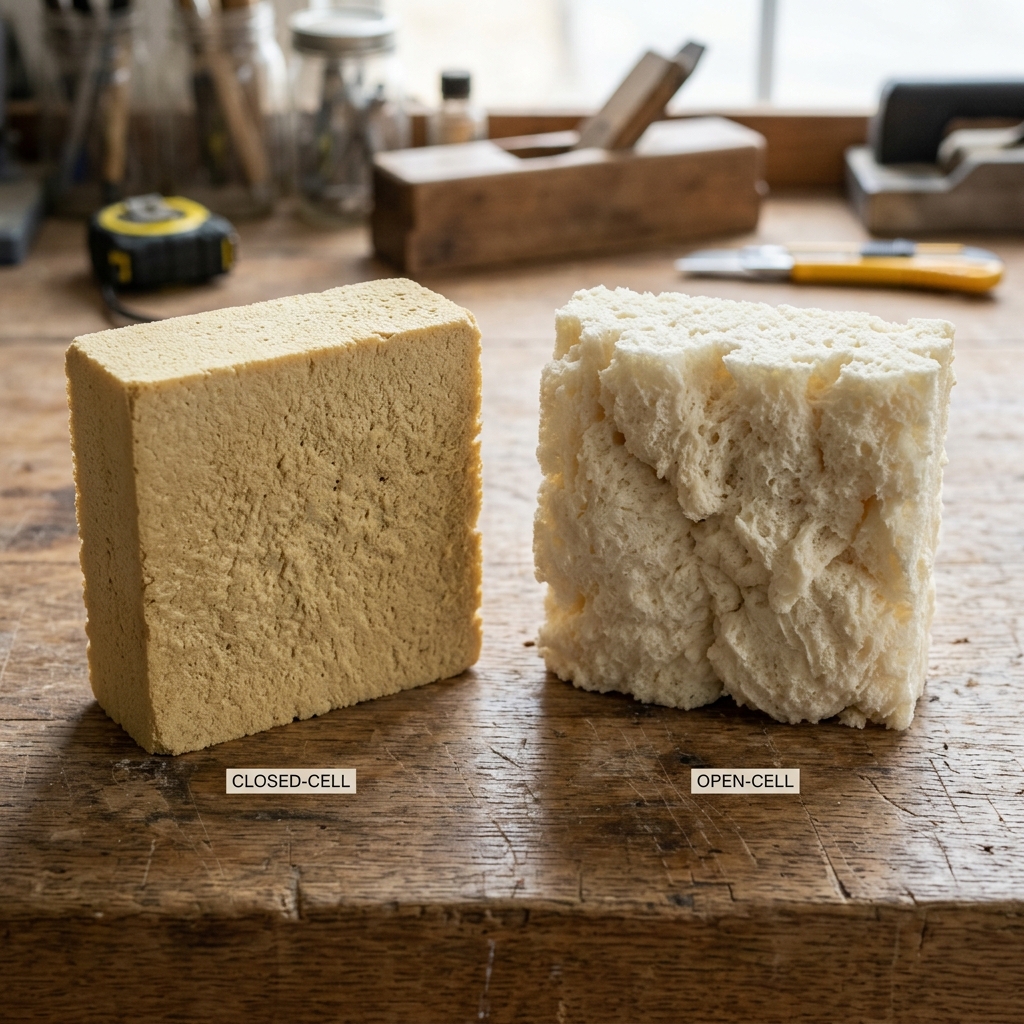
If you’ve looked into spray foam insulation for your McAllen home, you’ve probably run into the open-cell vs. closed-cell question. Both are spray foam. Both are significantly better than fiberglass batts in hot climates. But they behave very differently, and in the Rio Grande Valley specifically, that difference matters.
Here’s a plain-English breakdown of what each type does and which one makes more sense for most South Texas homes.
The Basics: What Makes Them Different
Both open-cell and closed-cell spray foam start as liquid and expand when applied. The difference is in their cellular structure after they cure:
Open-cell foam expands to about 100 times its liquid volume. The cells in the foam “open” and fill with air during expansion. The result is a soft, flexible material, similar in texture to a sponge. It’s less dense, less expensive per square foot, and has a lower R-value per inch.
Closed-cell foam expands to about 30–40 times its volume. The cells close in on themselves during curing, trapping a gas inside (rather than air). The result is a rigid, hard material, much denser and more structurally solid. It has a higher R-value per inch and acts as a vapor barrier.
That structural difference drives everything else.
Side-by-Side Comparison for RGV Applications
| Property | Open-Cell | Closed-Cell |
|---|---|---|
| R-value per inch | ~3.5–3.8 | ~6.0–7.0 |
| Vapor barrier | No | Yes (at 2″ thickness) |
| Air seal | Yes | Yes |
| Water resistance | Low — absorbs moisture | High — resists moisture |
| Rigidity | Soft, flexible | Hard, structural |
| Cost (relative) | Lower | Higher (roughly 2x per sq ft) |
| Best for | Interior walls, sound attenuation | Attics, exterior walls, crawl spaces |
Why the Vapor Barrier Matters in South Texas
This is the key factor that tips the decision toward closed-cell for most RGV attic applications.
The Rio Grande Valley has high humidity, although not as extreme as Houston, but enough that moisture management is a real concern. When warm, humid outdoor air hits a cool surface (like the underside of a roof deck that’s being cooled by conditioned air below), condensation can form. Over time, moisture in the attic structure causes wood rot, mold, and insulation degradation.
Closed-cell spray foam, applied directly to the roof deck, creates a vapor barrier at that boundary. Moisture can’t get through it. Open-cell foam, applied the same way, will allow moisture to pass, and if you’re conditioning the attic space (which unvented attic applications do), you can end up with moisture accumulation in the open-cell foam itself.
In humid climates, building science guidance generally recommends closed-cell for unvented attic assemblies. The RGV qualifies.
When Open-Cell Makes Sense
Open-cell isn’t the wrong choice for every application in South Texas, it just has a more limited set of appropriate uses.
Interior wall cavities: Open-cell is popular in interior walls for its sound attenuation properties. It fills cavities completely (it expands more), and since it’s not in contact with the exterior envelope, the vapor permeability and moisture resistance are less critical.
Interior sound control: Between rooms, around theater rooms, for noise reduction between floors, open-cell’s softer, more sound-absorbing structure outperforms closed-cell.
Cost-constrained projects where moisture risk is low: If budget is a hard constraint and the application is interior (or in a well-ventilated, low-humidity area), open-cell can make sense.
When Closed-Cell Is the Clear Choice
Attic roof deck (unvented attic): The most common high-impact application in RGV homes. Closed-cell is the appropriate material here, vapor barrier, high R-value per inch, and moisture resistance all matter.
Exterior walls: If you’re building new or doing a significant renovation where walls are open, closed-cell in the wall cavity adds R-value, air sealing, and structural rigidity.
Crawl space rim joists: Moisture from the ground makes closed-cell the clear choice in these applications (though most McAllen homes are slab-on-grade).
Any location with direct moisture exposure potential: Anywhere humid outdoor air or water vapor could be a factor.
The Cost Difference, And How to Think About It
Closed-cell typically costs roughly twice as much per square foot as open-cell, that’s worth factoring in.
But for attic applications in South Texas, the question isn’t just cost per square foot, it’s cost per inch of R-value, combined with the vapor barrier benefit you can’t get from open-cell. When you account for needing more open-cell inches to match the R-value of closed-cell, and add in the moisture risk of the wrong choice, closed-cell is usually the appropriate investment for the RGV attic.
A good insulation contractor will explain the tradeoffs for your specific home rather than defaulting to whichever product has the better margin.
Frequently Asked Questions
Can you mix open-cell and closed-cell in the same project?
Yes, and it’s sometimes done. For example, closed-cell on the exterior-facing surfaces (roof deck, exterior walls) and open-cell in interior walls. A knowledgeable contractor can design this correctly.
Does closed-cell spray foam require a thermal barrier or ignition barrier?
Yes. Building codes require spray foam to be covered by a thermal barrier (typically drywall) in occupied spaces, or an ignition barrier in certain attic applications. Your contractor will know the applicable requirements for your jurisdiction.
How long does the installation take for a typical RGV attic?
Most residential attic spray foam jobs in McAllen can be completed in a day, sometimes less depending on attic size and access. You’ll want to stay out of the area for 24 hours after application while the foam cures and off-gasses.
Will closed-cell spray foam make my attic smell?
There’s a temporary odor during and immediately after installation from the blowing agents in the foam. It dissipates within 24–72 hours. After curing, closed-cell spray foam is odorless.
The Bottom Line
For most South Texas attic applications, which is where spray foam has the biggest impact on your AC bill, closed-cell spray foam is the better choice. The higher R-value per inch, vapor barrier properties, and moisture resistance matter more in the RGV’s heat and humidity than in drier climates where open-cell is sometimes appropriate for attic use.
Open-cell has a place in interior walls and sound attenuation applications. But if someone is recommending an open-cell application for your unvented attic in McAllen, it’s worth getting a second opinion.
Questions about which type is right for your home? Mission Air Conditioning installs both types in McAllen and the Rio Grande Valley. We’ll assess your home and give you a straight recommendation without product pushing. Request a free consultation or give us a call.