

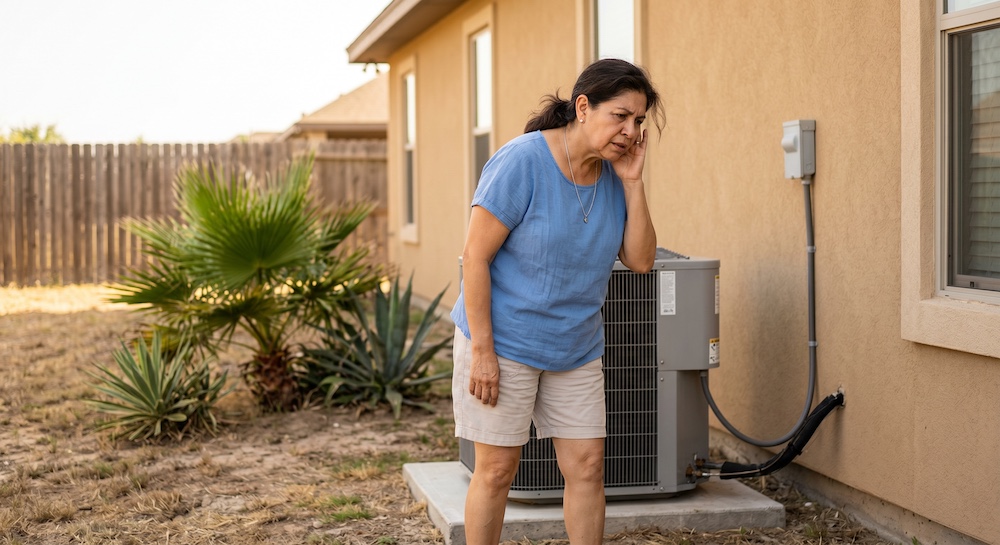
Your AC system is designed to run quietly. When it starts making sounds you don’t recognize — or sounds that have gotten progressively louder over the season — that’s your system trying to tell you something. The tricky part is knowing which noises are warning signs that require immediate attention versus which ones are just minor issues that can wait.
Here’s a guide to the most common AC sounds RGV homeowners report, what’s likely causing them, and what to do about each one.
Banging or Clanging
What it usually means: Something is loose or has broken inside the unit.
A banging sound — especially from the outdoor unit — often means a component has come loose: a connecting rod, piston pin, or crankshaft inside the compressor. It can also mean a loose fan blade is striking the casing as it rotates.
What to do: Turn off the system and call for service. Running the unit with a broken internal component can cause additional damage quickly, and what might be a repair today could become a full compressor replacement if the problem is ignored. This is one of the sounds that warrants a same-day call.
Hissing or Bubbling
What it usually means: A refrigerant leak.
A hissing sound — sometimes combined with a bubbling or gurgling noise — is a strong indicator of refrigerant escaping through a leak in the system. Refrigerant under pressure makes a distinct hiss as it escapes through cracks or worn fittings.
What to do: Don’t ignore this one. A refrigerant leak means your system will gradually lose its ability to cool, and refrigerant release is an environmental and health concern. A technician needs to locate and repair the leak and recharge the system to the correct level. If your home has already stopped cooling effectively, these two issues are likely connected.
Squealing or Screeching
What it usually means: A belt or motor bearing problem.
Older AC systems use a belt-driven blower motor — if that belt is worn or slipping, it produces a squealing sound. In newer systems, squealing or screeching usually points to a failing motor bearing. High-pitched metallic screeching from the outdoor unit can also indicate compressor issues under severe stress.
What to do: A belt replacement is a straightforward fix and relatively inexpensive. Motor bearings and compressor issues are more involved. Either way, don’t keep running the system once you hear this sound — metal-on-metal contact gets worse quickly.
Rattling
What it usually means: Loose components, debris, or a failing electrical part.
Rattling is one of the more common sounds and fortunately often one of the more benign ones. The most frequent cause is simply debris — leaves, twigs, or grass clippings — that have gotten inside the outdoor unit and are being struck by the fan blade. A quick visual inspection of the outdoor unit can rule this out.
Other causes of rattling include loose screws or panels on the unit, a failing contactor (an electrical component that controls the compressor), or loose components in the ductwork.
What to do: Check for visible debris first. If the rattling continues with no obvious foreign material, schedule a service call to have the electrical components and panel inspections done. A loose panel or electrical issue can escalate if left alone.
Clicking When Cycling On or Off
What it usually means: Completely normal — usually.
A single click when the system starts or shuts off is a normal sound produced by the electrical relay that starts the compressor. You should expect to hear this.
When it’s a problem: Continuous clicking — especially if the system seems to be trying to start and failing — indicates a defective relay or a failing capacitor. Capacitors are the components that provide the power jolt needed to start the compressor and fan motors. A failed capacitor is a very common repair, especially in systems that have been running heavily through a South Texas summer.
What to do: If the clicking is happening repeatedly without the system successfully starting, call for service. A capacitor replacement is typically a quick and affordable repair.
Humming
What it usually means: Electrical issue or loose components.
A low, continuous humming from the outdoor unit is sometimes normal — the motor produces a hum. But a louder-than-normal humming, or humming accompanied by the system struggling to start, often points to electrical issues: a failing capacitor, a failing motor, or loose wiring.
What to do: If the humming is noticeably louder than it used to be, or if it’s accompanied by the system not running correctly, schedule a diagnostic. Electrical issues in HVAC systems are worth addressing sooner rather than later.
Banging from Inside the Vents (Ductwork)
What it usually means: Duct expansion, debris, or a pressure imbalance.
The banging sound that comes from inside the walls or ceilings — not from the actual unit — is usually the ducts expanding and contracting as temperature changes. This is common in South Texas where temperature swings can be significant. It’s generally not a concern unless it’s a new sound or getting louder.
Occasional banging from vents can also happen when a filter is clogged and the system is drawing air harder than normal, causing thin duct sections to flex. Replace the filter if you haven’t recently.
When to Call Right Away
Some sounds warrant an immediate call — don’t wait:
- Grinding or screeching metal-on-metal from the outdoor unit
- Banging that sounds like something is loose or striking inside the unit
- Hissing accompanied by the system losing its ability to cool
For other sounds that are more gradual or intermittent, a scheduled service call within a day or two is appropriate. The key is not to ignore new sounds and hope they go away — they almost never do on their own.
If the noise has coincided with your AC losing cooling capacity or if you’re in a situation where it’s not safe to be without AC, don’t wait.
Honest Diagnostics from Mission Air Conditioning
Mission Air Conditioning serves McAllen and the RGV with straightforward AC diagnostics. If you’re hearing a sound you can’t identify, give us a call — we’ll tell you exactly what it is, what’s causing it, and what it’ll take to fix it. No guesswork, no upselling.
Call Mission Air Conditioning today to schedule an AC diagnostic or repair visit.