

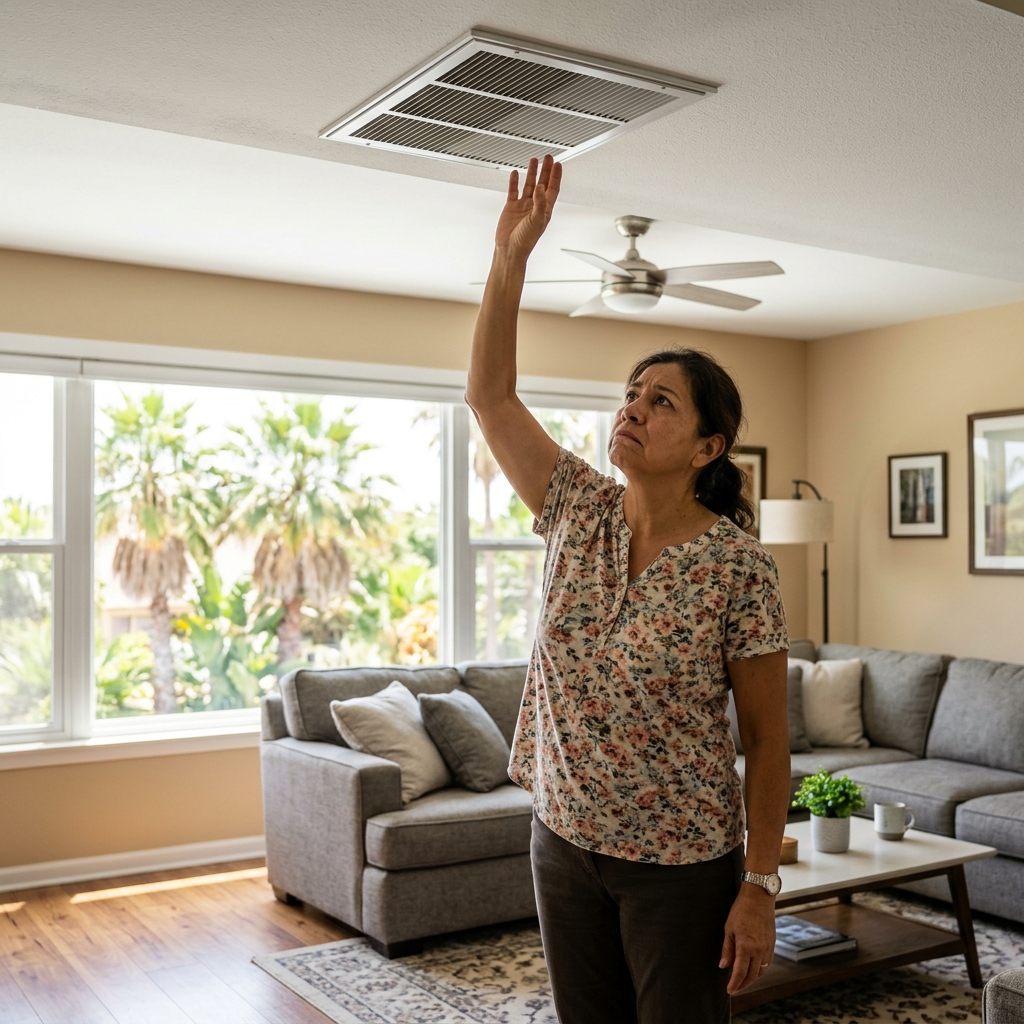
You hit the thermostat, hear the system kick on, and feel warm air coming out of the vents. In McAllen in the middle of summer, that’s not a minor inconvenience. It’s a problem you need fixed today.
The good news: AC blowing warm air usually has a pretty short list of causes. Some you can address yourself right now. Others need a technician, but knowing what you’re dealing with helps you have a better conversation when you call.
Here’s a rundown of the most common culprits and how to approach each one.
Most Likely Causes of AC Blowing Warm Air in McAllen
Before assuming something is broken, rule out the simple stuff:
Thermostat set to “heat” or “fan only”? It sounds basic, but a thermostat accidentally switched to heat mode — or set to “fan” instead of “cool”, will blow unconditioned air through your vents. Check that it’s set to COOL and that the temperature is set below your current room temperature.
Thermostat batteries low? A dying thermostat can behave erratically. If yours is battery-powered, swap them out.
Both the indoor and outdoor units running? Go outside and check your condenser. If the outdoor unit isn’t running but the air handler inside is, you’ll get warm air. A tripped breaker, a blown fuse, or a failed capacitor on the outdoor unit can cause exactly this.
The Most Likely Causes
1. Refrigerant Leak
Refrigerant is the substance that actually absorbs heat from your home’s air and moves it outside. When the system is low on refrigerant — almost always because of a leak somewhere in the system — it loses the ability to cool properly. The result is warm or barely-cool air coming from your vents, often accompanied by:
- Ice forming on the refrigerant lines or evaporator coil
- The system running constantly without cooling the house
- Higher-than-usual electricity bills
Refrigerant doesn’t “run out” under normal conditions — if your system is low, there’s a leak. Adding refrigerant without finding and fixing the leak is a temporary fix at best. A technician needs to locate the leak, repair it, and then recharge the system to the proper level.
This is one of the more common causes of warm air in RGV homes, especially in older systems.
2. Dirty or Frozen Evaporator Coil
The evaporator coil (inside your air handler) is where the refrigerant absorbs heat from your home’s air. If the coil gets caked with dust and grime — usually from poor filtration or a clogged filter — airflow across it drops, and the coil can freeze solid. A frozen coil can’t do its job, and you get warm air.
Signs of a frozen coil:
- Warm air from vents despite the system running
- Ice visible on the lines coming from the indoor unit
- Water pooling around the air handler as ice melts
The first step is to turn the system off (switch to “fan only”) and let the coil thaw — which can take a few hours. While it’s thawing, check your air filter. If it’s clogged, replace it. Once thawed, the system may work normally if the coil was the only issue. But if the coil itself is damaged or dirty beyond what better filtration will prevent, a cleaning or repair is needed.
3. Dirty Condenser Coils
The outdoor condenser unit has coils too — they release the heat removed from your home into the outside air. In McAllen, these coils can accumulate significant amounts of dirt, debris, and sometimes cottonwood or vegetation buildup. When they’re clogged, the system can’t shed heat efficiently and starts struggling to cool.
You can sometimes see this on the outdoor unit — if the fins look matted with dirt or debris, that’s a sign. Some homeowners clean the exterior of the condenser with a garden hose (gently, with the unit off), but a thorough cleaning typically requires a technician with the right tools to clean from the inside out.
4. Compressor Problems
The compressor is the heart of your AC system — it pressurizes the refrigerant so it can absorb and release heat. A failing compressor may still run but not create enough pressure differential to cool effectively, resulting in warm air.
Compressor issues are more common in older units and in systems that have had refrigerant problems (running low on refrigerant damages the compressor over time). This is a more serious repair — compressor replacement is expensive enough that on an older unit, replacement of the whole system is often the better call.
5. Ductwork Leaks
If your ductwork has leaks or disconnected sections in the attic — very common in older South Texas homes — conditioned air can escape into the attic before it ever reaches your vents. What comes out of the vents may feel warm because a significant portion of the cooled air is being lost to the unconditioned attic space (which in a McAllen summer can hit 140°F or more).
Signs that ductwork may be the issue: some rooms get cool while others stay warm, or airflow from certain vents feels weak.
6. Electrical Issues
A failed capacitor on the outdoor unit is one of the more common causes of the outdoor condenser not running. Capacitors are relatively inexpensive to replace, and it’s one of the more straightforward repairs a technician can do. If the outdoor unit is completely silent when the system should be running, a bad capacitor or a tripped breaker is often the reason.
What To Do Right Now
- Check your thermostat settings and make sure it’s on COOL.
- Look at your air filter — if it’s gray and clogged, replace it immediately.
- Go outside and check if the condenser is running.
- Check your breaker panel for any tripped breakers connected to the AC.
- If none of those fix it, call for service — especially in peak summer. An AC that’s not cooling in McAllen is a health issue, not just a comfort one.
For anything beyond a filter swap or a reset breaker, you’re into technician territory. The longer a refrigerant leak, frozen coil, or compressor problem goes unaddressed in South Texas heat, the worse it tends to get.
Frequently Asked Questions
Can I add refrigerant myself if my AC is low?
No — and you shouldn’t try. Refrigerant handling requires EPA certification. More importantly, if the system is low, adding refrigerant without finding the leak is a waste of money. The leak needs to be repaired first.
How long can I run my AC if it’s blowing warm air?
If you suspect a frozen coil, running the system harder can make it worse. Switch to fan-only mode to let it thaw, then check the filter. For other issues — refrigerant leaks, compressor problems — continued operation doesn’t usually cause immediate damage, but it won’t get your house cool either. Get it looked at as soon as you can.
How much does it cost to fix an AC blowing warm air in McAllen?
Depends entirely on the cause. A refrigerant recharge (after fixing the leak) might run $200–$600. A capacitor replacement is typically $150–$350. A compressor is significantly more. See our breakdown of what AC repair costs in South Texas for a fuller picture.
The Bottom Line
AC blowing warm air in McAllen usually comes down to one of a handful of problems: thermostat settings, a refrigerant leak, a frozen or dirty evaporator coil, a failing compressor, ductwork issues, or an electrical fault at the outdoor unit. Start with the simple checks, and if none of those resolve it, get a technician out before the heat gets worse.
AC not cooling? Mission Air Conditioning serves McAllen and the Rio Grande Valley with same-day service when available. We’ll diagnose the problem honestly and quote you before we touch anything. Schedule a service call or give us a call.