

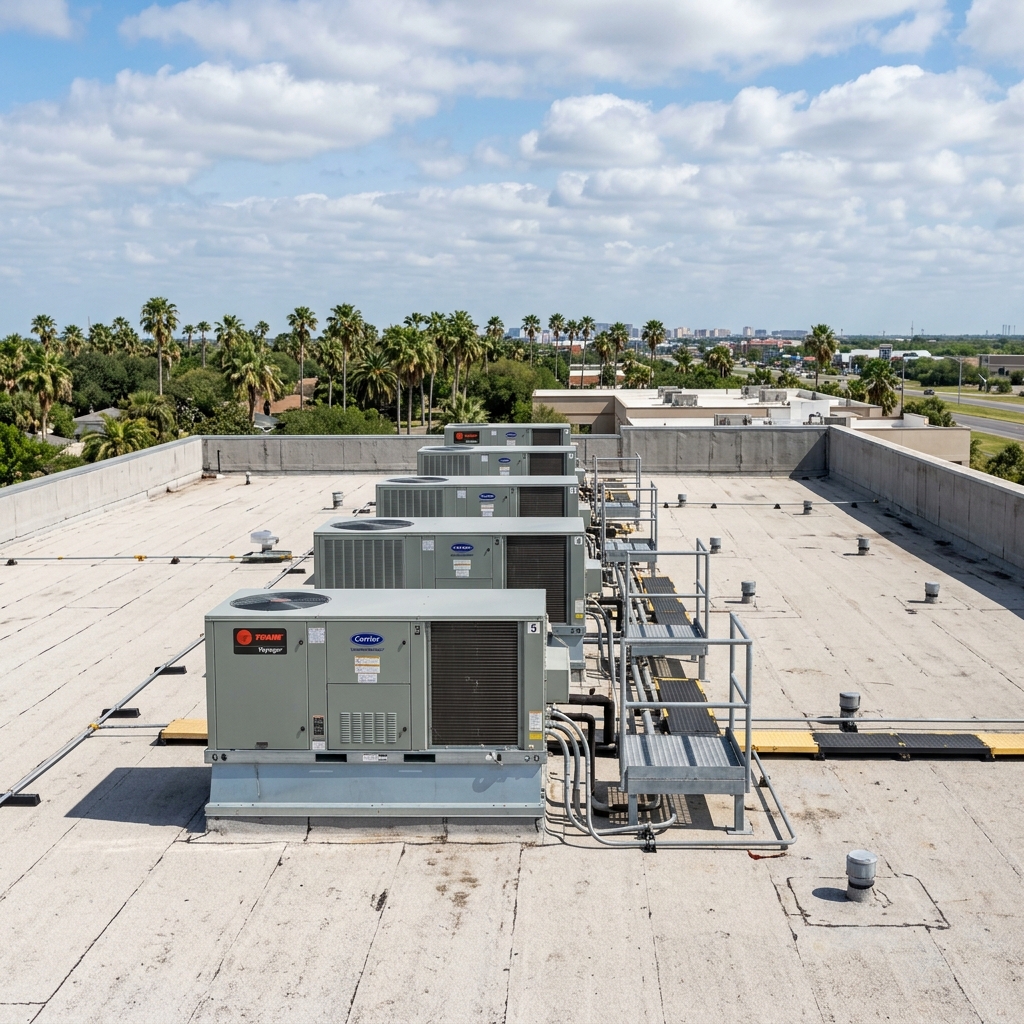
If you own or manage a commercial property in McAllen, a strip plaza, an office, a bank, or a retail space, your HVAC situation is fundamentally different from a residential one. Rooftop units (RTUs) are the standard for most commercial buildings in South Texas, and when one fails or ages out, the replacement process has enough unique considerations that it’s worth understanding before you’re in a crisis.
This post walks through what rooftop unit replacement actually involves for commercial properties in the Rio Grande Valley. Get to know the process, the cost factors, and how to avoid the most common mistakes.
Why Rooftop Units Are Common in Commercial Buildings
Most commercial properties in McAllen use packaged rooftop units rather than split systems. The reasons are practical: rooftop units house all components (compressor, condenser, evaporator, air handler) in a single cabinet on the roof. This keeps mechanical equipment off the ground (valuable for retail and office spaces), simplifies the duct connection to the interior, and makes service more accessible, everything is in one location.
The downside: when a rooftop unit needs significant repair or replacement, you’re working at height and handling large equipment. That changes logistics and cost compared to ground-level residential work.
Signs Your Commercial RTU Needs Replacement
The signals are similar to residential but happen faster, commercial units in South Texas often run more hours per day and serve larger spaces:
Age: Most commercial RTUs have a service life of 12–18 years. In the RGV, where they run nearly year-round and deal with extreme heat, expect the lower end of that range. A 15-year-old RTU is overdue for evaluation.
Frequent breakdowns: One or two repairs per year is a red flag on an older commercial unit. The cost of repeated service calls, plus the business disruption of downtime, often tips the math toward replacement.
Tenant complaints: If occupants in a zone are consistently too hot or uncomfortable, the unit serving that zone may have degraded capacity, compressor wear, refrigerant loss, or simply being undersized for the current configuration.
High energy costs: Older RTUs operate at lower efficiency than modern units. The gap between a 12-year-old RTU and a modern high-efficiency replacement can be 30–40% in energy consumption, meaningful on a commercial utility bill.
R-22 refrigerant: Pre-2010 commercial units use R-22, which is no longer manufactured and is increasingly expensive to service. Any commercial RTU still on R-22 is a strong replacement candidate.
The Replacement Process
Step 1: Assessment and load calculation
Before specifying a replacement unit, the right contractor will assess the building’s load requirements, not just spec the same size as the existing unit. Buildings change: they get better windows, added insulation, expanded tenant buildouts. A load calculation ensures the replacement is properly sized rather than just matched to the old nameplate.
Step 2: Equipment selection
Commercial RTUs come in a wide range of sizes, efficiencies, and features. Key decision points:
- Tonnage (must match the calculated load, not just the previous unit’s size)
- Efficiency (EER/IEER) — higher efficiency units cost more upfront but reduce operating costs
- Refrigerant type — modern units run R-410A or newer refrigerants (not R-22)
- Single-zone vs. multi-zone capability (zoning for mixed-use or multi-tenant buildings)
- Brand and lead time — commercial equipment can have lead times of 2–8 weeks depending on size and configuration; plan ahead
Step 3: Crane and rigging
This is where commercial differs most from residential. Rooftop units weigh 500–2,000+ pounds depending on size. Removing the old unit and setting the new one requires a crane, either a boom truck or a larger mobile crane depending on building height and roof access. Crane logistics need to be coordinated in advance: access path, parking, utility clearances.
Step 4: Electrical and mechanical connections
The new unit needs to connect to the existing electrical supply (often 3-phase commercial power), the ductwork below, and any building automation/thermostat system. If the new unit has different electrical requirements, panel work may be needed.
Step 5: Startup and commissioning
A commercial RTU isn’t just turned on, it needs to be commissioned: verified airflow, refrigerant charge confirmed, controls programmed, and all zones checked for proper operation.
What Affects the Cost
Commercial RTU replacement is more expensive than residential on both the equipment and labor sides. Rough ranges for the Rio Grande Valley:
| Unit Size | Typical Installed Cost Range |
|---|---|
| 3–5 ton (small retail) | $6,000–$12,000 |
| 6–10 ton (mid-size commercial) | $10,000–$20,000 |
| 12–20 ton (larger spaces/plazas) | $18,000–$35,000+ |
These ranges include equipment, labor, crane, electrical connections, and startup. They can vary significantly based on:
- Roof height and accessibility — taller buildings or difficult access require larger cranes
- Building age and electrical infrastructure — older buildings sometimes need panel upgrades
- Ductwork condition — if ducts are damaged or need modification
- Lead time and emergency premium — replacing a failed unit in July costs more than a planned replacement in spring
Common Mistakes to Avoid
Waiting for complete failure. In commercial settings, a failed AC unit in summer means tenant complaints, lease issues, and potential business interruption claims. The better approach is proactive evaluation of aging units, assess them at 12–14 years and plan replacement before they fail.
Spec-ing the same tonnage without a load calculation. Buildings change over time. An honest contractor runs the numbers rather than assuming the old unit’s size was right.
Ignoring lead times. Equipment lead times in the commercial HVAC world can be 4–8 weeks for larger or specialty units. If you’re planning ahead, order early. If you’re in a crisis, ask about expedite options and temporary cooling.
Choosing based on price alone. Commercial HVAC installation quality varies. A unit that’s improperly set on the roof curb, with refrigerant charge off or ductwork not properly balanced, will underperform for its entire service life. The installation matters as much as the equipment.
Frequently Asked Questions
Do I need permits for commercial RTU replacement in McAllen?
Yes. Commercial HVAC work in McAllen requires permits. A reputable contractor handles this as part of the project. Building inspections are required upon completion.
Can a commercial RTU be repaired instead of replaced?
Yes, if the unit is relatively young and the repair is isolated. For units over 12 years old or with compressor issues, the math usually favors replacement. especially given the efficiency gains from modern equipment.
How long does the replacement take?
Most single-unit replacements can be completed in one day once the equipment arrives. The crane work itself is typically a few hours. Multi-unit projects take longer and need to be scheduled to minimize disruption.
Who do I call for commercial RTU work in McAllen?
Look for a licensed commercial HVAC contractor with experience in rooftop unit replacement. Ask specifically about their crane coordination process, their load calculation approach, and who handles the permits. See what to look for in a reliable HVAC company for general guidance that applies to the commercial context.
The Bottom Line
Commercial rooftop unit replacement in McAllen involves more planning, logistics, and cost than a residential swap — but the process is well-defined when you work with an experienced contractor. The key is not waiting for a crisis: assess aging RTUs proactively, plan for lead times, and prioritize installation quality as much as equipment cost.
Managing a commercial property in the RGV with aging rooftop units? Mission Air Conditioning handles commercial HVAC work across McAllen and South Texas, from diagnosis to crane coordination to commissioning. We’re a local, family-owned operation, not a regional contractor who sends a different crew every time. Call us or request a commercial evaluation.