

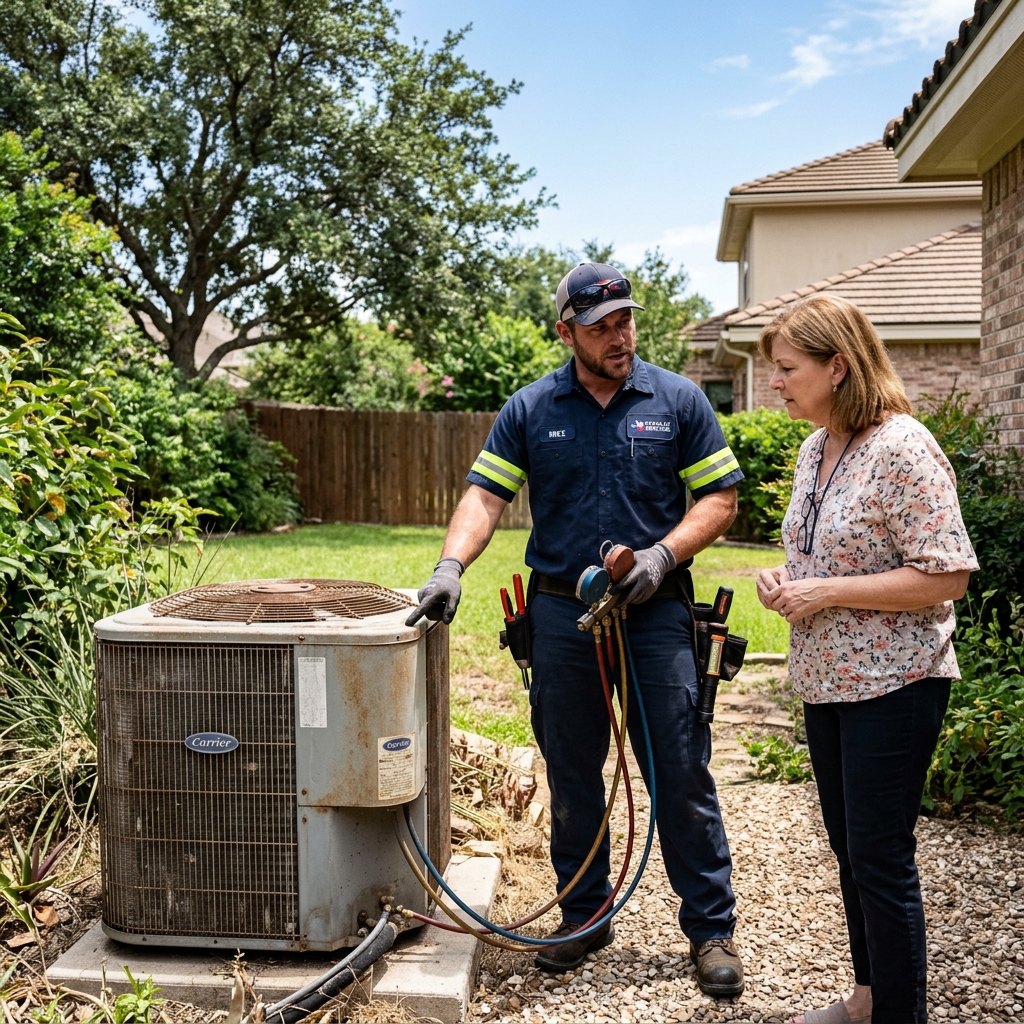
Getting a repair estimate and wondering if you should just replace the whole thing? It’s one of the most common questions RGV homeowners face, and the answer isn’t always obvious. Repair the existing system and you’re out a few hundred dollars now. Replace it and you’re spending several thousand, but you might be done with the headaches for the next decade.
Here’s a clear-eyed look at how to tell which choice actually makes sense for your situation.
The Age Rule: Start Here
The single most useful number is your AC unit’s age. Central air conditioners in South Texas typically last 12–15 years, often shorter than in cooler climates because the system runs so much longer each year. If your unit is pushing 12 years or older, that changes the calculus on every repair decision.
Why? Because an aging system has multiple components approaching the end of their service life simultaneously. Fixing one thing today doesn’t prevent the next thing from failing next summer. You’re essentially paying to extend the life of a system that’s going to need replacement anyway.
If you don’t know your unit’s age, check the data plate on the outdoor condenser, there’s usually a manufacture date printed there, or a serial number you can look up online.
The 50% Rule
A widely-used guideline in the HVAC industry: if a repair costs 50% or more of what a replacement would cost, replace it, especially if the unit is older than 8–10 years.
For example: if you’re quoted $2,500 to replace a compressor on a 12-year-old system, and a new system installed runs $5,500, the repair is nearly half the replacement cost. You’d be spending $2,500 to extend the life of a unit that may have 2–3 years left in it. That money is better applied toward a new, warrantied system.
The 50% rule isn’t absolute, a nearly-new unit that needs a major repair is worth fixing. But for older systems, it’s a useful gut-check.
Signs the Tipping Point Is Here
Beyond age and repair cost, watch for these patterns:
You’ve Had Multiple Repairs in the Last 2 Years
One breakdown is bad luck. Two or three in quick succession is the system telling you something. Once an AC starts failing in multiple places, the failures tend to accelerate, especially here in South Texas, where the system works harder than almost anywhere else in the country.
The System Uses R-22 Refrigerant
Older systems (manufactured before 2010) use R-22 refrigerant, which has been phased out under EPA regulations. R-22 is now scarce and expensive, sometimes $100 or more per pound. If your system has a refrigerant leak and runs on R-22, you’re paying a premium every time it needs a recharge, and you can’t upgrade to a more efficient system without replacing the whole thing.
It’s Not Keeping Up Anymore
If your AC runs almost constantly and still can’t get the house below 80°F on a hot afternoon, or certain rooms are always warmer than others, the system may have lost significant capacity. Sometimes this is fixable (refrigerant, coil cleaning, duct issues). But in older units, it often means the compressor is degraded and the unit genuinely can’t put out what it used to.
Your AEP Bills Have Climbed Significantly
AC efficiency degrades over time. A unit that ran at 13 SEER when new may be operating at the equivalent of 10 SEER after years of wear. In the RGV, where you’re running the AC 10–11 months a year, that efficiency loss shows up on your bill. A new, higher-SEER unit can meaningfully reduce your monthly electricity costs, sometimes enough to offset the replacement cost over a few years.
The Repair Requires a Major Component
Some repairs are minor: a bad capacitor, a dirty filter coil, a thermostat issue. Others involve major components:
- Compressor replacement — often $1,500–$2,500+ in labor and parts
- Evaporator or condenser coil replacement — $800–$2,000+
- Refrigerant line set replacement — adds cost and complexity
When a major component fails on an older system, it’s worth stopping to do the math before authorizing the repair.
When Repair Is Still the Right Call
Replacement isn’t always the answer. Repair makes clear sense when:
- The unit is under 8 years old and the repair is relatively minor
- The problem is isolated (a capacitor, a contactor, a clogged drain line) and the rest of the system is in good shape
- The repair cost is well under 50% of a replacement
- You know the unit has been well-maintained and doesn’t have a history of repeated failures
A trustworthy technician will tell you honestly where your system stands, not push you toward a new unit when a simple fix will get you another 5+ good years.
The Honest Conversation
The best HVAC contractors won’t just quote the repair or the replacement, they’ll walk you through the tradeoffs. Things like: how much life realistically remains in the current unit, what the efficiency gap looks like between old and new, and what your break-even point is on the investment.
For most McAllen homeowners, the answer becomes clear pretty quickly once you have those numbers in front of you. See our breakdown of what AC replacement costs in McAllen to get a realistic sense of the replacement side of the equation.
Frequently Asked Questions
Is it ever worth repairing an AC that’s 15 years old?
Rarely. At 15 years in the RGV, a unit has likely run the equivalent of 20+ years of service in a northern climate. The risk of additional failures is high, and the efficiency gap between that unit and a modern replacement is significant. Most technicians will tell you the same thing.
What if my AC is newer but keeps having issues?
Repeated failures on a newer unit point to either a manufacturing defect, a poor original installation, or an improperly sized system. A second opinion from a qualified technician can help determine whether the problem is fixable or systemic.
How do I know if my system uses R-22?
Check the data plate on your outdoor unit. It will list the refrigerant type. If it says R-22 (also labeled HCFC-22), you have an older system that’s increasingly expensive to service.
Does replacing the AC also mean replacing the furnace or air handler?
Not always, but often the indoor air handler is replaced at the same time, especially if it’s a similar age to the outdoor unit, or if the new system is a different refrigerant type. A contractor can assess whether your existing air handler is compatible with a new outdoor unit.
The Bottom Line
The decision to replace rather than repair comes down to a few key factors: your unit’s age, the cost and severity of the needed repair, how often it’s been failing, and whether it’s still keeping up with South Texas summers. When the math stops adding up in favor of another repair, replacement is the smarter investment, both for your comfort and your electricity bill.
Not sure which way to go? Mission Air Conditioning gives you a straight answer. We’ll assess your system, explain your options honestly, and help you make the decision that actually makes sense for your situation, not the one that’s best for our revenue. Call us or request a free evaluation.