

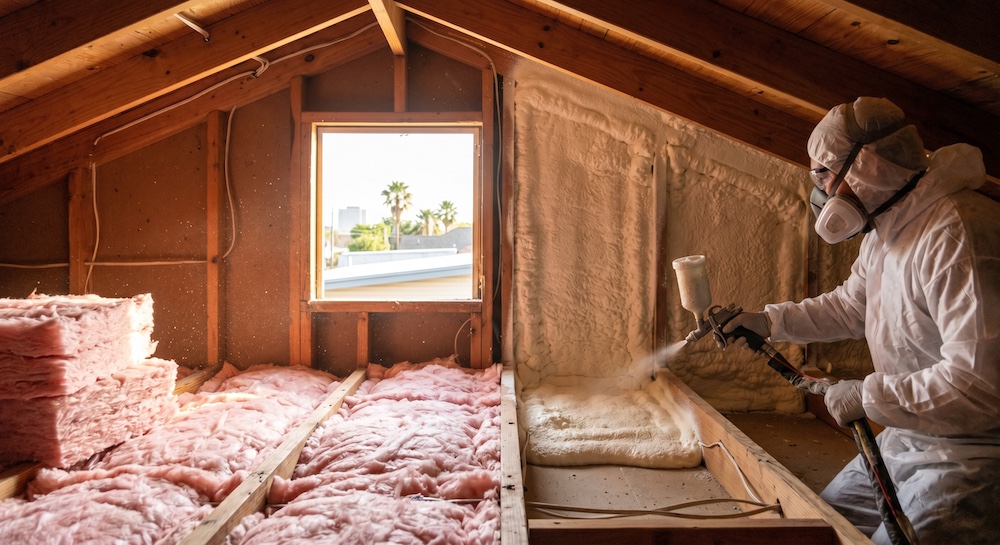
If you’re thinking about upgrading the insulation in your McAllen home, you’ll probably run into two main options: fiberglass batts (the pink fluffy stuff you’ve seen in attics and walls) and spray foam. Both can do the job — but in South Texas, the difference in performance between these two materials is more dramatic than it would be in a cooler, drier climate.
Here’s a practical comparison to help you understand which makes more sense for homes in the RGV.
The Core Difference: How They Work
Fiberglass insulation works by trapping air in tiny glass fibers. Those pockets of still air resist heat transfer. It’s effective at what it does, relatively affordable, and has been the standard choice in residential construction for decades.
Spray foam insulation works differently. It’s applied as a liquid that expands and hardens, filling gaps, cracks, and voids completely. Closed-cell spray foam creates a rigid, airtight barrier that doesn’t just slow heat transfer — it also stops air infiltration almost entirely.
That distinction — air sealing — is where spray foam pulls significantly ahead in South Texas conditions.
Why Air Sealing Matters So Much in the RGV
In a mild climate, a modest amount of air infiltration (outside air leaking into the home through gaps and cracks) is manageable. In McAllen in July, it’s a meaningful problem. When it’s 105°F outside and your attic is pushing 150°F, every bit of hot air that seeps into your conditioned space is heat your AC has to remove.
Fiberglass insulation fills the spaces between studs and joists, but it doesn’t seal the gaps. Air can still move through and around it. Spray foam expands to fill those gaps and creates an air barrier that fiberglass simply can’t match.
The practical result: homes insulated with spray foam in the RGV typically see a more noticeable reduction in energy costs and hot spots than homes insulated with fiberglass alone — because they’re addressing both heat transfer and air infiltration at the same time.
Moisture and Humidity
This is another area where South Texas conditions matter. The RGV has significant humidity, and moisture infiltration through walls and ceilings can cause mold growth, wood rot, and structural issues over time.
Closed-cell spray foam acts as a vapor barrier in addition to an air barrier. It resists moisture infiltration from the outside, which reduces the risk of moisture-related damage inside the wall cavities and attic.
Fiberglass insulation, on the other hand, does not resist moisture. If fiberglass insulation gets wet, it can become a habitat for mold and loses its insulating effectiveness until it dries out. In a climate with heavy summer humidity and the occasional tropical weather event, that’s a real consideration.
R-Value: Understanding the Numbers
R-value measures thermal resistance — how well a material resists heat flow. Higher R-value means better insulation.
- Fiberglass batts typically achieve R-3 to R-4 per inch of thickness
- Open-cell spray foam achieves approximately R-3.5 per inch
- Closed-cell spray foam achieves R-6 to R-7 per inch — nearly twice that of fiberglass
For attic applications in South Texas, the Department of Energy recommends R-30 to R-60. You can achieve that with fiberglass, but it requires significantly more material than closed-cell spray foam.
The higher R-value per inch of closed-cell spray foam matters particularly in spaces where you don’t have room for thick insulation — like unvented attic spaces, crawlspaces, and some wall applications.
Cost: The Honest Comparison
Spray foam insulation costs more upfront — typically 2–3 times the installed cost of fiberglass batts. That’s a real consideration for homeowners on a tight budget.
The counterargument is long-term value. Spray foam, when applied correctly, doesn’t sag, settle, or need to be replaced. Fiberglass can shift over time, especially in attic applications. Spray foam also tends to pay back its premium through energy savings more quickly in a climate like the RGV — where the AC runs heavily for so many months of the year — than it would in a milder climate.
For whole-home re-insulation projects, the upfront cost difference is substantial. For targeted applications — sealing an attic that’s clearly losing efficiency, insulating a specific problem area — the premium is often justified by the results.
Where Spray Foam Makes the Most Sense in RGV Homes
Attics: South Texas attics reach extreme temperatures. An attic that’s been properly sealed with spray foam stays significantly cooler than one with traditional fiberglass and ventilation, which directly reduces the load on your AC.
Rim joists and sill plates: These areas where the floor framing meets the foundation are common air infiltration points. Spray foam seals them completely.
Knee walls in older homes: Homes with knee walls (short walls in upper floors adjacent to attic space) are notorious for air leakage. Spray foam is far more effective here than batts.
Additions and remodels: When walls are already open during renovation, it’s an ideal time to upgrade insulation with spray foam.
Which Is Right for Your Home?
The honest answer is: it depends on your budget, the current condition of your insulation, and what you’re trying to accomplish. For a new construction project or a whole-home re-insulation, spray foam delivers better long-term performance in the South Texas climate. For smaller projects or budget-constrained situations, high-quality fiberglass installed carefully can still be a worthwhile improvement over doing nothing.
If you’re noticing signs that your home’s insulation isn’t performing well — high energy bills, hot spots in certain rooms, an AC that runs constantly but can’t keep up — it’s worth having a conversation about what options make sense for your specific home.
Mission Air Conditioning provides spray foam insulation services for McAllen and RGV homeowners, along with honest guidance on whether it makes sense for your situation.
Call Mission Air Conditioning today to schedule a consultation on insulation options for your South Texas home.