

If you are shopping for a new air conditioner in McAllen this fall, you have probably heard that the efficiency rules changed. They did, in stages. The SEER2 minimums you are buying against today took effect on January 1, 2023, and they have not changed since.
What did change around the start of 2026 was the refrigerant inside new systems and the federal tax credit that used to help pay for them. Both affect what a replacement costs and which units are on the truck.
This guide lays out the SEER2 requirements for 2026 in plain terms for Rio Grande Valley homeowners, what changed and when, and how to use this fall to plan a replacement before next summer. Mission Air Conditioning walks McAllen, Edinburg and Mission homeowners through these choices with an in-home assessment, with no pressure and no upselling.
What Are the SEER2 Requirements in 2026 for Texas Homes?
A new central air conditioner installed in Texas in 2026 must be rated at least 14.3 SEER2 if it is a split system under 45,000 Btu/h. Larger split systems of 45,000 Btu/h and up must be at least 13.8 SEER2.
Texas falls in the Department of Energy’s Southeast region, which is why its minimums sit above the 13.4 SEER2 national floor for split air conditioners. Heat pumps follow a national minimum of 14.3 SEER2 regardless of region.
| System type | Federal minimum in Texas (since Jan 1, 2023) | ENERGY STAR certified (Version 6.2) |
|---|---|---|
| Split central AC, under 45,000 Btu/h | 14.3 SEER2 | 15.2 SEER2 and 12.0 EER2 |
| Split central AC, 45,000 Btu/h and up | 13.8 SEER2 | 15.2 SEER2 and 12.0 EER2 |
| Split heat pump | 14.3 SEER2, 7.5 HSPF2 | 15.2 SEER2, 11.0 EER2, 7.8 HSPF2 |
| Single-package central AC | 13.4 SEER2 (national minimum) | 15.2 SEER2 and 11.5 EER2 |
In Texas, the installation date is what counts. In the Southeast, DOE’s regional standard applies to the date a system is installed, so a contractor in McAllen cannot legally install a split AC that falls below the regional minimum, even if it was built years ago.
Your current system is not affected. These minimums apply to new equipment, and nothing in them requires you to replace a working system.
What Changed With SEER2, and Why the Numbers Look Lower
SEER2 is a new way of testing the same thing: how much cooling an air conditioner delivers per unit of electricity over a season. DOE’s updated test procedure changed the test conditions, including the external static pressure the system is tested against, and DOE noted that the new ratings generally come out as different numbers than the old ones.
The same unit scores lower on the new test. DOE set the 2023 minimums on both tests: the Southeast split-AC minimum is 15 SEER on the old test and 14.3 SEER2 on the new one, and the national minimum is 14 SEER, or 13.4 SEER2. A 14.3 SEER2 rating and a 15 SEER rating describe the same current federal minimum, measured under two different tests.
2023 also raised the bar. Before 2023, a split AC installed in Texas needed only 14 SEER, and the national minimum was 13 SEER, so the current rules ask for more efficiency as well as a new label.
Compare SEER2 to SEER2. If one quote lists SEER and another lists SEER2, the numbers are not directly comparable. Ask every contractor for the SEER2 rating of the exact outdoor and indoor combination being installed.
If you are weighing whether to pay more for a system well above the minimum, Mission Air has already covered whether a higher SEER rating is worth the extra cost for RGV homes.
What Did Change Around 2026: Refrigerant and the Tax Credit
The two changes that matter most for a 2026 replacement are the switch to new refrigerants and the end of the federal efficiency tax credit.
New systems moved to A2L refrigerants in 2025. Since January 1, 2025, EPA has limited new home and light commercial AC and heat pump systems to refrigerants with a global warming potential of 700 or less. New systems now use refrigerants such as R-454B and R-32, which EPA lists as acceptable for new equipment and which carry the “A2L” safety classification under ASHRAE Standard 34. An R-410A system can go in only if its equipment was made or imported before 2025.
Leftover R-410A equipment can still be installed. EPA’s original rule gave contractors until January 1, 2026 to install systems built from components made or imported before 2025. A final rule EPA published on May 26, 2026, and which took effect July 27, 2026, removed that deadline, so pre-2025 R-410A equipment can be installed until the existing supply runs out. EPA said the change responds to the supply chain problems with R-454B equipment seen in 2025, and that the remaining R-410A inventory could be a lower-cost option for consumers.
Your R-410A system can still be repaired. EPA’s rules do not restrict the continued use of existing systems, and they allow systems to be serviced and repaired throughout their useful life.
The federal tax credit is gone for new installs. The Energy Efficient Home Improvement Credit, known as 25C, which covered up to $600 for a qualifying central AC and up to $2,000 a year for a qualifying heat pump, ended early under a 2025 federal law. The IRS states that no credit is allowed for property placed in service after December 31, 2025.
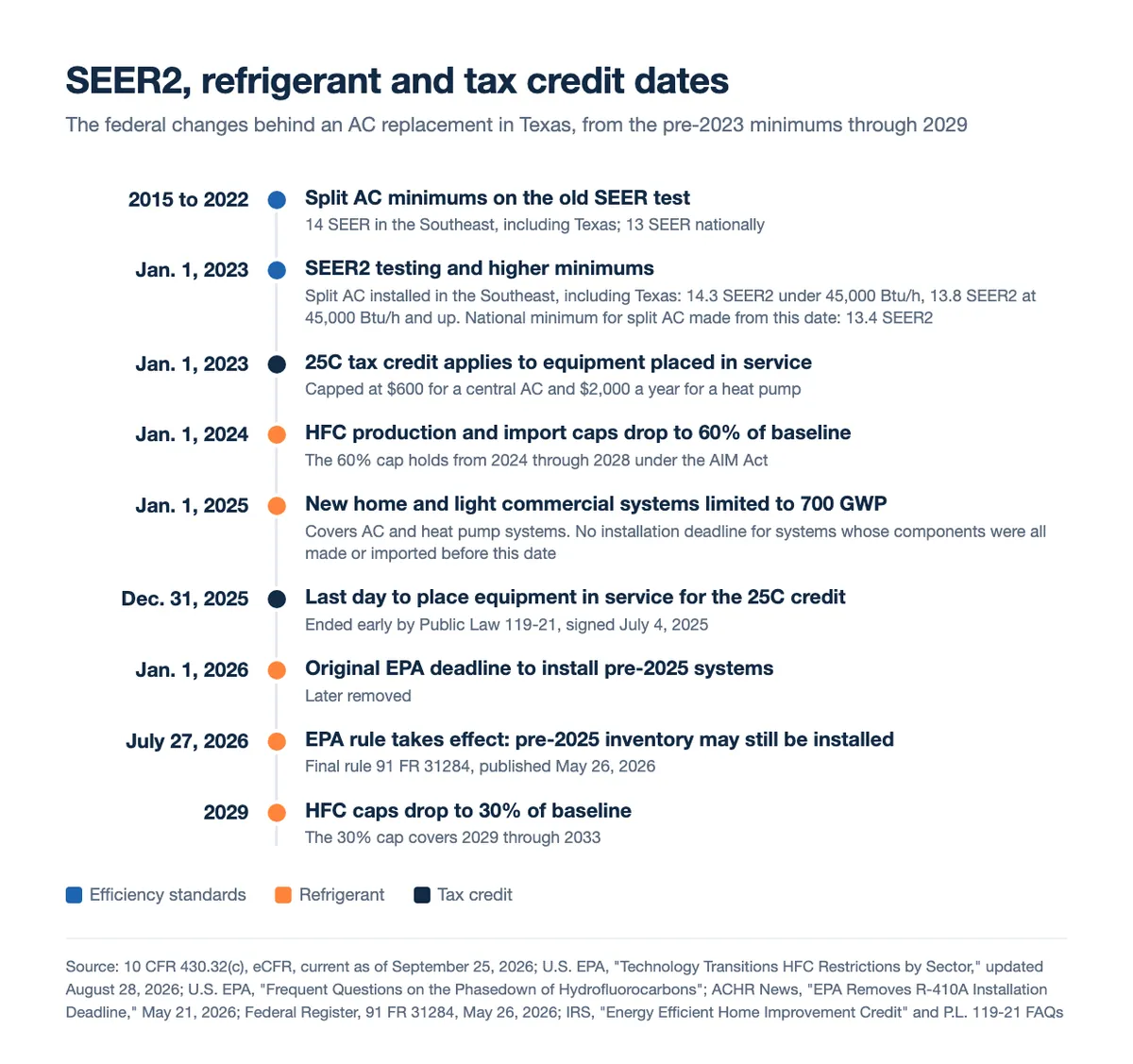
| Date | What took effect |
|---|---|
| 2015 to 2022 | Split ACs installed in Texas had to be at least 14 SEER |
| January 1, 2023 | SEER2 testing and the current minimums (14.3 and 13.8 SEER2 for split ACs in Texas) |
| January 1, 2024 | Federal HFC production and import caps dropped to 60% of baseline |
| January 1, 2025 | New AC and heat pump systems limited to refrigerants under 700 GWP (A2Ls such as R-454B and R-32) |
| December 31, 2025 | Last day to place equipment in service for the 25C tax credit |
| January 1, 2026 | Original EPA cutoff for installing pre-2025 R-410A equipment (later removed) |
| July 27, 2026 | EPA rule takes effect allowing pre-2025 R-410A inventory to be installed until depleted |
| 2029 | HFC caps drop to 30% of baseline |
How the Rules Affect AC Prices and Availability
The refrigerant switch was expected to push equipment prices up, and the shrinking supply of R-410A may raise what it costs to keep an older system running.
A2L equipment costs more. In late 2024, major manufacturers said to expect higher prices for A2L systems: Carrier’s CEO projected a base price about 10% above R-410A equipment, rising to 15% to 20% over two years, and Lennox’s CEO said A2L replacements would cost over 10% more, according to ACHR News.
The new refrigerant had a rough first year. In 2025, refrigerant maker Honeywell announced a 42% surcharge on R-454B orders placed on or after February 15, citing demand that domestic production could not meet, according to ACHR News.
R-410A supply keeps shrinking. Under the AIM Act, the federal caps on HFC production and imports sit at 60% of historic baseline through 2028, drop to 30% in 2029, and reach 15% in 2036. In its May 2026 rule, EPA itself acknowledged that the price of legacy refrigerants such as R-410A may rise as the phasedown continues.
What that means for your quote. A leftover R-410A unit and a new A2L unit can both be legal to install this fall. If a quote uses an R-410A unit, compare its price against an A2L unit of the same size and SEER2 rating, and keep in mind that any future refrigerant recharge for that unit will come from a shrinking supply. Mission Air’s guide to what an AC replacement costs in McAllen covers the other factors that move the price.
Why Fall Is the Window to Plan a Replacement in the RGV
Fall is the time to plan an AC replacement in the Rio Grande Valley, because the pressure of summer is off while the next one is still months away.
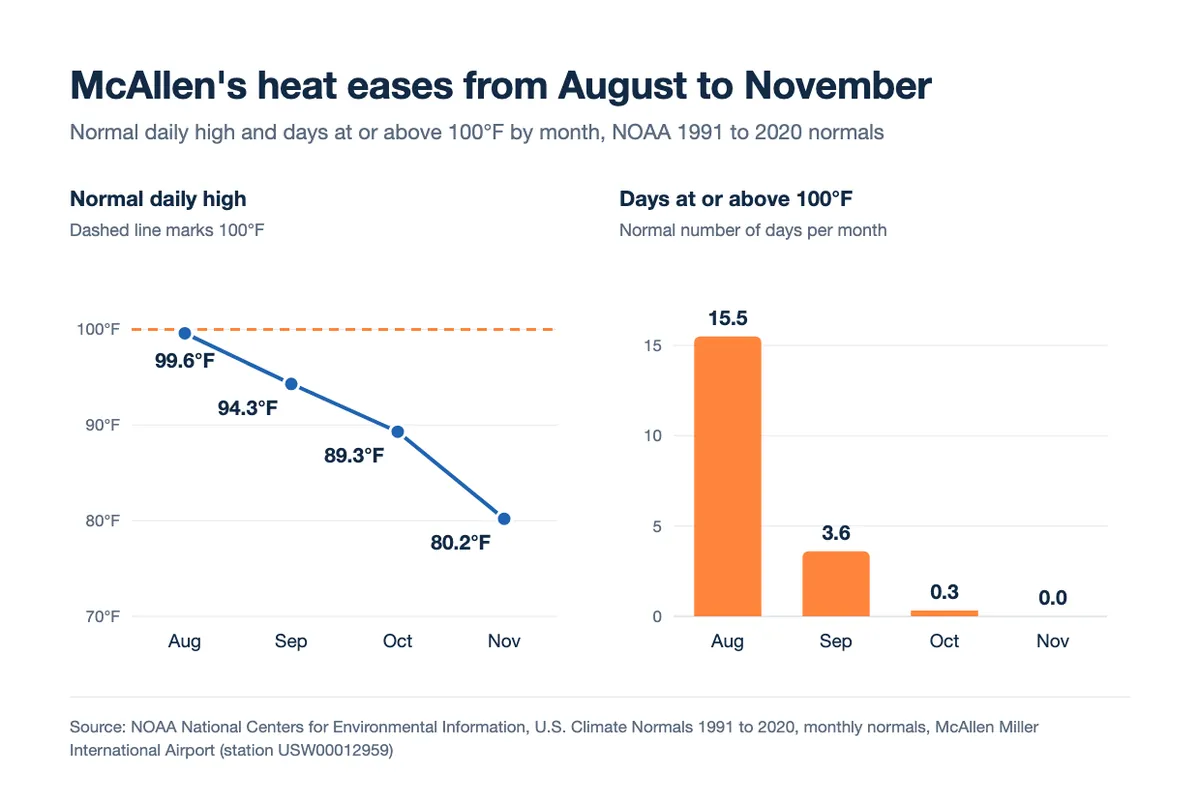
A day without AC during the install is easier in fall than in August. NOAA’s climate normals for McAllen show an average August high of 99.6°F, with about 15 days at or above 100°F. By October the average high drops to 89.3°F, and by November it is 80.2°F.
You have time to compare quotes on equal terms. With the SEER2 rules settled and two refrigerants on the market, fall gives you time to get quotes that list the same things: SEER2, refrigerant type and system size.
Spring still works too. Mission Air’s look at the best time of year to replace your AC names late winter to early spring as the ideal window and fall as a solid second option, and planning this fall puts you ready for either.
Your AC still runs in October, so an aging unit is still telling you something. McAllen averages about 16 days at or above 90°F in October, and a system that struggles through those days is unlikely to get easier next August.
What to Ask Before You Sign
Before you sign, get written answers on the SEER2 rating of the exact system, its refrigerant, how it was sized, how charge and airflow will be confirmed, and whether a heat pump fits better.
What is the SEER2 rating of this exact combination? ENERGY STAR notes that split systems must be matched with appropriate indoor coil components to meet its efficiency criteria, so the rating that counts is the one for the outdoor and indoor pair on your quote.
Which refrigerant does it use? The answer will usually be R-410A or an A2L such as R-454B or R-32, and it tells you which side of the transition the unit falls on.
How was the system sized? DOE’s Federal Energy Management Program warns that oversizing, improper charging and leaky ducts lead to efficiency losses, discomfort and a shorter equipment life. Mission Air’s replacement process starts with an in-home assessment of the home’s size, layout, insulation and comfort needs, which the company describes as “no upselling, just the perfect fit.”
Will the installer confirm refrigerant charge and airflow? ENERGY STAR states that failing to confirm proper charge and airflow may reduce energy efficiency and shorten equipment life. Mission Air finishes each installation with testing and a walkthrough before the crew leaves.
Should this be a heat pump instead? Heat pumps carry the same 14.3 SEER2 minimum and the same refrigerant rules, and Mission Air’s comparison of heat pump vs. central AC walks through the choice for South Texas homes.
FAQ
What is the minimum SEER2 rating for 2026?
In Texas, the minimum for a new split central AC is 14.3 SEER2 under 45,000 Btu/h and 13.8 SEER2 at 45,000 Btu/h and up, which are Southeast-region minimums, and a single-package AC needs at least 13.4 SEER2, which is the national minimum. All of these took effect on January 1, 2023; no new SEER2 minimum for home central AC took effect in 2026.
What are the key changes in HVAC regulations for 2026?
The 2026 changes that matter most for homeowners involve refrigerant and taxes. The federal 25C tax credit does not apply to equipment placed in service after December 31, 2025, and EPA’s May 2026 rule lets contractors keep installing leftover pre-2025 R-410A equipment until the supply runs out, while new systems use A2L refrigerants such as R-454B and R-32.
Does a 14.3 SEER2 system qualify for a tax credit?
A 14.3 SEER2 system installed in 2026 does not qualify for the federal 25C credit, because the IRS allows no credit for property placed in service after December 31, 2025. Under the ENERGY STAR Version 6.2 criteria, a split AC also needs at least 15.2 SEER2 and 12.0 EER2 to be ENERGY STAR certified, so 14.3 SEER2 meets the legal minimum only.
What SEER2 rating do I need for an RGV home?
Every new split AC installed in an RGV home needs at least 14.3 SEER2 under 45,000 Btu/h, and ENERGY STAR certification starts at 15.2 SEER2. Whether a higher rating pays off in McAllen’s long cooling season is a separate question, covered in Mission Air’s guide to whether a higher SEER rating is worth the extra cost.
Is my current R-410A system still legal to keep and repair?
Yes, an existing R-410A system can stay in place and be repaired. EPA’s rules do not restrict the continued use of existing systems, allow them to be serviced throughout their useful life, and allow repair components to keep being made and sold.
Plan Your Replacement Before Next Summer
The SEER2 rules have been stable since 2023; the refrigerant switch and the end of the tax credit are what make a 2026 replacement different. A clear quote that lists the SEER2 rating, the refrigerant and how the system was sized is the best way to compare your options.
Mission Air Conditioning handles AC replacement across McAllen, Edinburg, Mission and the Rio Grande Valley, starting with an in-home assessment and an honest comparison of the options. Look over Mission Air Conditioning’s HVAC services and the available financing options, then contact Mission Air Conditioning to plan your replacement this fall.