

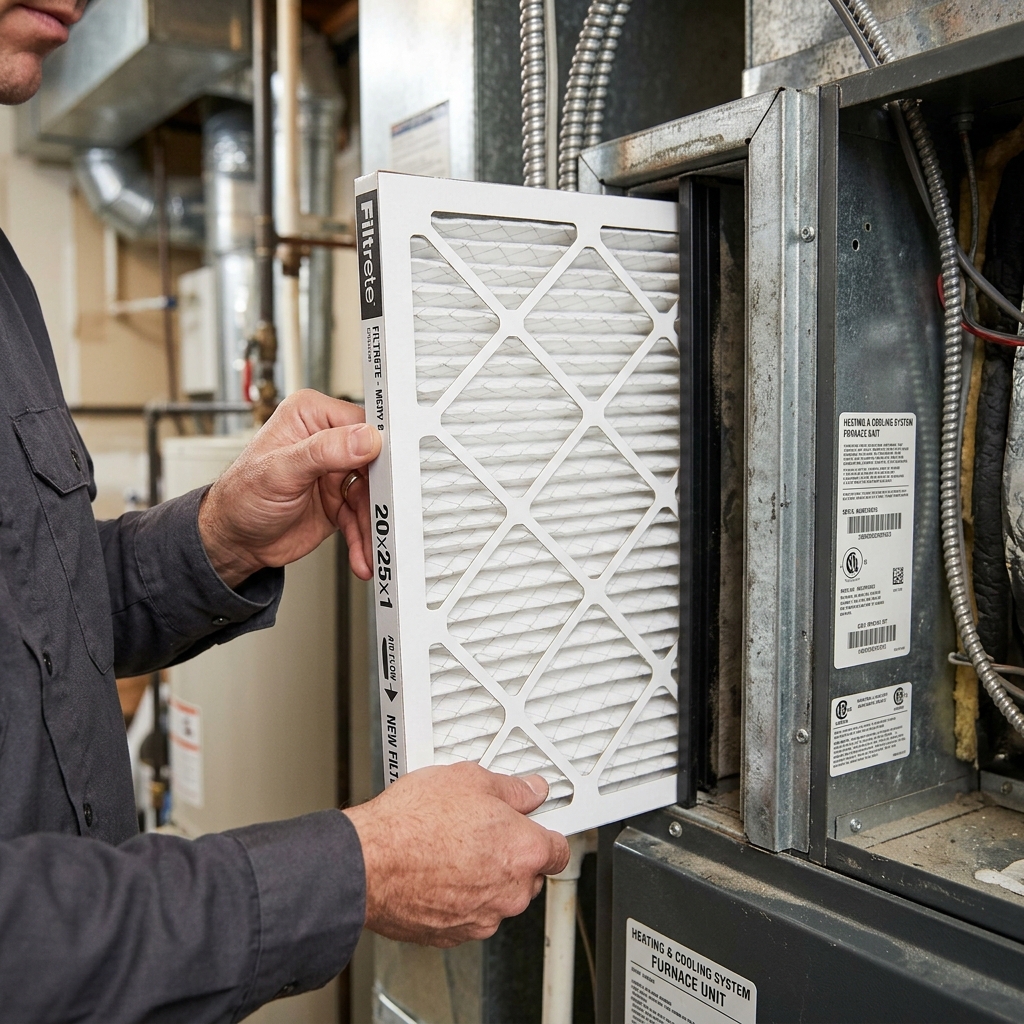
If you’ve googled “how often should I change my AC filter,” you’ve seen answers ranging from 30 days to 90 days. The honest answer for McAllen homeowners: every 30–45 days during peak season, and no longer than 60 days the rest of the year.
Standard recommendations are written for climates where AC runs 4–6 months a year. Your system runs 10–11 months. More runtime means more air pulled through the filter, which means it loads up faster. A “90-day filter” in South Texas often looks like a 9-month filter in Minnesota.
Why Filter Changes Matter More Than You Think
The air filter’s job is to protect the components inside your AC, primarily the evaporator coil, from dust and debris. When the filter gets clogged, airflow through the system drops. That causes a cascade of problems:
- The evaporator coil gets colder (less warm air moving across it), which can cause it to freeze up
- The blower motor works harder to pull air through the restriction, using more electricity and accumulating more wear
- Debris that gets past an overloaded filter coats the evaporator coil, reducing heat transfer and making the system progressively less efficient
A dirty filter is one of the leading causes of AC freeze-ups caused by dirty filters, service calls, and reduced system lifespan in South Texas. It’s also the easiest maintenance item a homeowner can do themselves.
How to Change Your AC Filter: Step by Step
Step 1: Find your filter location
Most air handlers in South Texas homes have a filter slot on the side or bottom of the unit, typically in a utility closet or the garage. Some homes have filters in a return air grille mounted on the ceiling or wall instead. If you’re not sure where yours is, look for a grille with a latching frame, that’s the return, and the filter is usually right behind it.
Step 2: Note the size
Pull out the existing filter and check the dimensions printed on the cardboard frame. Common sizes in the RGV include 16x25x1, 20x25x1, and 14x25x1, but your home may be different. Take a photo so you know what to buy.
Step 3: Choose the right filter
Higher MERV ratings capture more particles but restrict more airflow. A MERV 13 filter in a system designed for MERV 8 significantly restricts airflow and can cause the exact problems you’re trying to prevent. For most McAllen homes, MERV 8 is the right balance, it catches dust, pollen, and most airborne particles without restricting airflow.
If someone in the home has allergies or asthma and you want better filtration, confirm with your HVAC company that your system’s blower can handle a higher MERV rating before upgrading.
Step 4: Install it correctly
Filters have an airflow direction arrow on the frame. That arrow should point toward the air handler, the direction air is traveling, not toward the return duct. Installing it backwards reduces effectiveness and can allow debris to bypass the filter.
Step 5: Set a reminder
The simplest system: a recurring phone reminder every 30 days from April through October, and every 45–60 days November through March. Keep a small stock of filters at home so there’s no reason to delay.
Which Filter Type Should You Buy?
| Filter Type | MERV Rating | Cost | Recommended? |
|---|---|---|---|
| Fiberglass | 1–4 | $1–3 | No — catches large debris only |
| Pleated | 8–11 | $5–15 | Yes — best balance for most homes |
| High-efficiency | 12+ | $15–30 | Only if system can handle it — ask first |
| Washable/reusable | Low | $20–40 | Not recommended in humid climates |
The bottom line: pleated MERV 8 filters are the right call for the vast majority of McAllen homes. Cheap fiberglass filters don’t do enough to protect your coil. High-efficiency filters restrict too much airflow unless your system is rated for them.
When a Filter Change Isn’t Enough
If you’ve been changing filters regularly and your system still underperforms, this means higher bills, weak airflow, warm rooms, the evaporator coil may need professional cleaning. Even with regular filter changes, coils accumulate a thin layer of debris over time. What a full HVAC tune-up covers includes coil inspection and cleaning if needed.
It’s also worth reviewing common HVAC maintenance mistakes in South Texas — filter changes are the most common one, but not the only one.
Frequently Asked Questions
How often should I change my AC filter in McAllen?
Every 30–45 days from April through October, and every 45–60 days the rest of the year. During high-dust periods in the Valley, err on the shorter end of that range.
What happens if I don’t change my AC filter?
Airflow to your system drops, forcing the blower motor to work harder. This raises your energy bill, can cause the evaporator coil to freeze, and accelerates wear on the entire system. Dirty filters are one of the leading causes of preventable AC failures in South Texas.
Is a higher MERV filter always better?
Not for every system. A MERV 13 filter captures more allergens and particles, but it also restricts more airflow. If your system’s blower isn’t powerful enough to pull air through a high-MERV filter, you’ll get the same problems as a clogged filter. Ask your HVAC tech what MERV rating your system is rated for.
Can I wash and reuse my AC filter?
Washable filters exist, but they’re not recommended in humid climates like McAllen. They require thorough drying before reinstalling, if reinstalled damp, they can harbor mold inside your air handler. Disposable pleated filters are a better choice here.
Keep It Simple
Mission Air Conditioning serves McAllen and the Rio Grande Valley. Our HVAC maintenance services include full system tune-ups, coil cleaning, and everything else that goes beyond a filter swap. If your system has been underperforming despite regular maintenance, we can diagnose what’s actually going on. Schedule online at missionaircon.com or give us a call.