

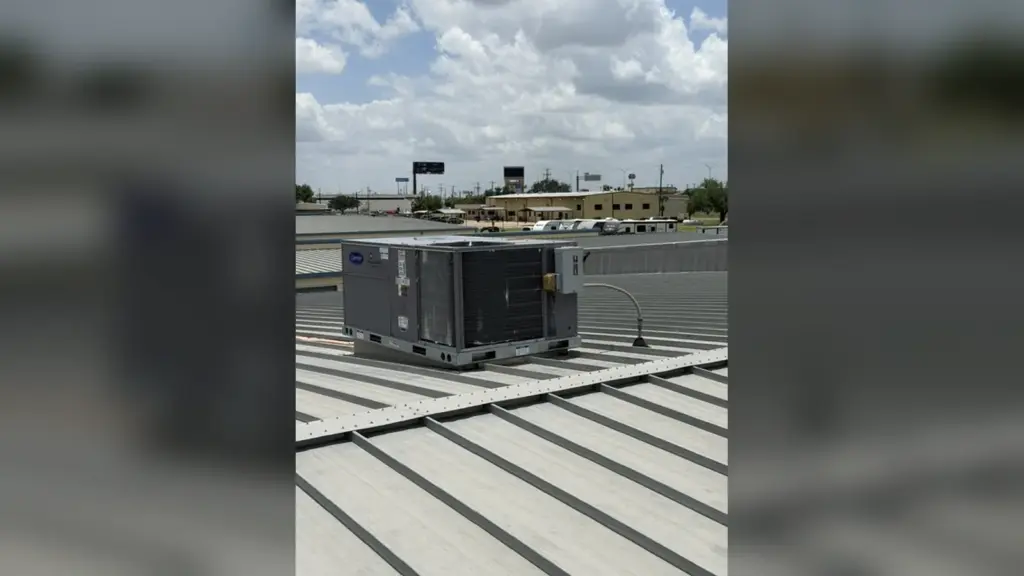
A rooftop unit can keep a McAllen office or retail space cool all summer and still waste money every single day it runs. The waste rarely shows up as a breakdown. It shows up as an electric bill that creeps higher each year while the unit runs a little longer every summer.
This guide is about commercial AC energy efficiency: the signs that a rooftop unit is losing it, where those signs appear on the bill and in the building, and what a maintenance visit can do about them. If you own or manage a plaza, clinic, restaurant or office in the Rio Grande Valley, Mission Air Conditioning can check your rooftop units and give you a straight answer on what is worth fixing, with no pressure and no upselling.
How Much of a Commercial Electric Bill Goes to Cooling?
Cooling and air movement together account for about a third of the electricity used in U.S. commercial buildings. According to the U.S. Energy Information Administration, cooling used about 14% of commercial building electricity in 2018, and ventilation, which includes moving cooled air around the building, used another 18%.
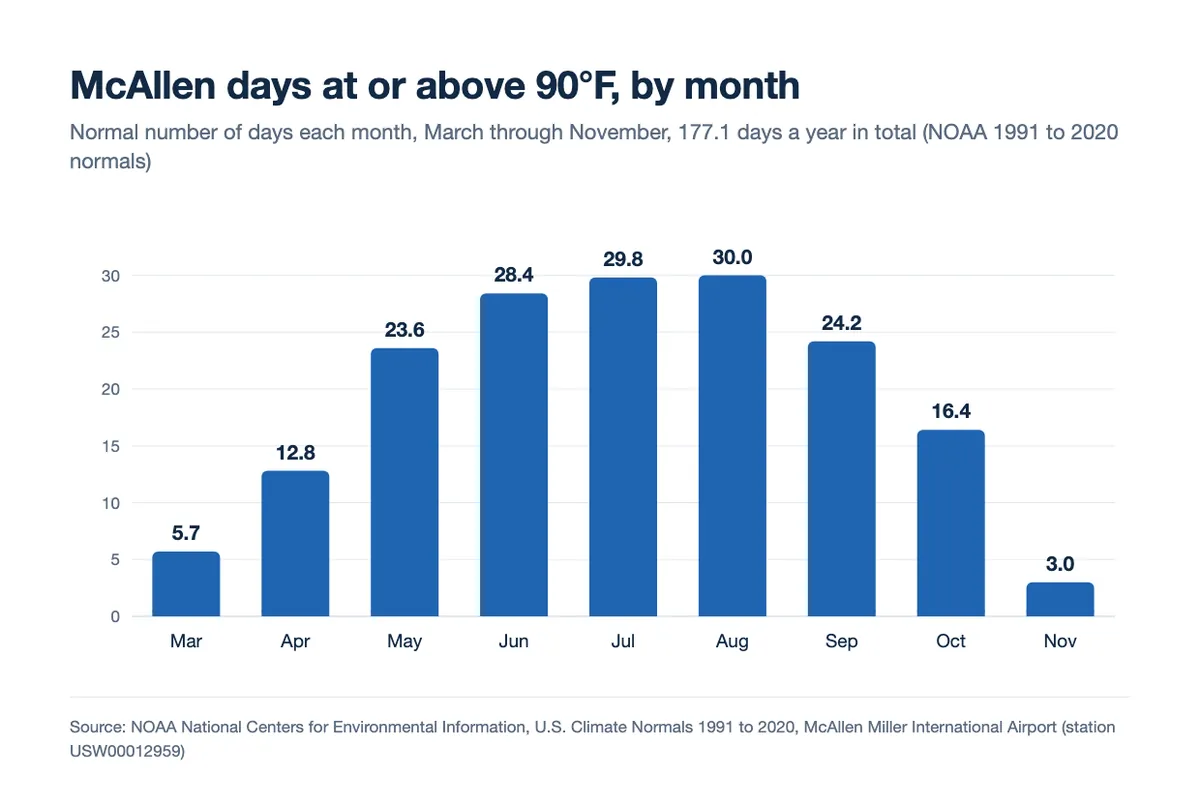
In McAllen, the cooling season is long. NOAA’s climate normals for McAllen Miller International Airport show about 177 days a year at or above 90°F, including about 40 days at or above 100°F.
Packaged rooftop units do much of that cooling. Researchers at the Pacific Northwest National Laboratory (PNNL) report that rooftop units are used in 46% of U.S. commercial buildings and serve more than 60% of commercial floor space.
When a rooftop unit loses efficiency, the loss lands on a major share of the building’s electricity, and in the RGV it keeps landing for most of the year.
The Demand Charge on Your Bill Keeps Climbing
A climbing demand charge on the electric bill can be an early sign that a commercial AC is losing efficiency, so watch demand, measured in kW, alongside usage in kWh.
Usage and demand are two different charges. Usage (kWh) is how much electricity the building consumed over the month. Demand (kW) is how hard the building pulled power at its busiest moment.
AEP Texas, the delivery utility for McAllen and Mission, bills non-residential accounts whose demand tops 10 kW under its “Secondary Voltage Service Greater Than 10 kW” rate schedule. On that schedule, the distribution charge is billed per kW of peak demand, and AEP Texas defines that peak as the power supplied during the single 15-minute period of maximum use in the billing month.
One hot afternoon can set the charge. A rooftop unit that has lost capacity has to run harder and longer on the hottest afternoons, and a single 15-minute stretch of heavy use is all it takes to set that month’s demand charge.
Pull the last 12 to 24 months of bills and compare the same months year over year. If kWh and kW are both climbing while your hours, tenants and equipment have stayed the same, the rooftop units are the first place to look. If your retail electric provider’s bill does not print the kW figure, ask the provider for it.
Signs You Can See and Hear in the Building
The signs to watch inside the building are short cycling, long run times, uneven cooling and sticky or musty air, and each one points to a specific kind of efficiency loss.
The unit starts and stops every few minutes. Frequent on-off cycling, known as short cycling, wastes energy because an air conditioner runs at low efficiency when it first starts. A 2005 ENERGY STAR fact sheet on home air conditioners notes that a unit takes about 10 minutes to reach peak efficiency. One common cause of short cycling is a unit that is too big for the space. ENERGY STAR, citing the Consortium for Energy Efficiency, reports that at least 25% of rooftop units are oversized, which increases energy costs and equipment wear. Mission Air’s residential guide to how short cycling works explains the mechanism, and the same physics applies on a roof.
The unit runs all afternoon and never catches up. Long run times on hot days often point to dirty coils or a refrigerant problem. ENERGY STAR notes that dirty coils reduce a system’s ability to cool and cause it to run longer.
One end of the building is always warm. Uneven cooling, such as a back office or a dining room corner that stays warm, often means the unit is moving less air or delivering less cooling than it was designed to. ENERGY STAR says airflow problems alone can reduce a system’s efficiency by up to 15%.
The space feels sticky or smells musty. An air conditioner dries the air by running long enough for moisture to condense on its coil and drain away, according to the same 2005 ENERGY STAR sheet, so a unit that short-cycles or drains poorly leaves a McAllen building feeling clammy. ENERGY STAR also warns that a plugged condensate drain can cause water damage and affect indoor humidity levels.
A unit showing these signs can keep running for years, working harder than it should to deliver the same comfort while the building pays for the difference.
What Is Going Wrong Inside the Rooftop Unit
A rooftop unit loses efficiency through a handful of faults that build up slowly: the wrong refrigerant charge, dirty coils, and dampers or controls that no longer work as designed.
A 2015 PNNL report on rooftop unit diagnostics puts numbers on three of those refrigerant-side and coil faults:
| Fault found on the roof | Efficiency lost | Seasonal efficiency lost | Extra energy cost per ton per year* |
|---|---|---|---|
| Refrigerant undercharged by 25% | About 15% | About 16% | About $60 |
| Indoor (evaporator) coil dirty enough to cut airflow in half | About 12% | About 10% | About $24 |
| Outdoor (condenser) coil dirty enough to cut airflow in half | About 22% | About 20% | About $80 |
*PNNL’s 2015 estimates assume electricity at $0.12 per kWh. Your actual cost depends on your rate and your hours.
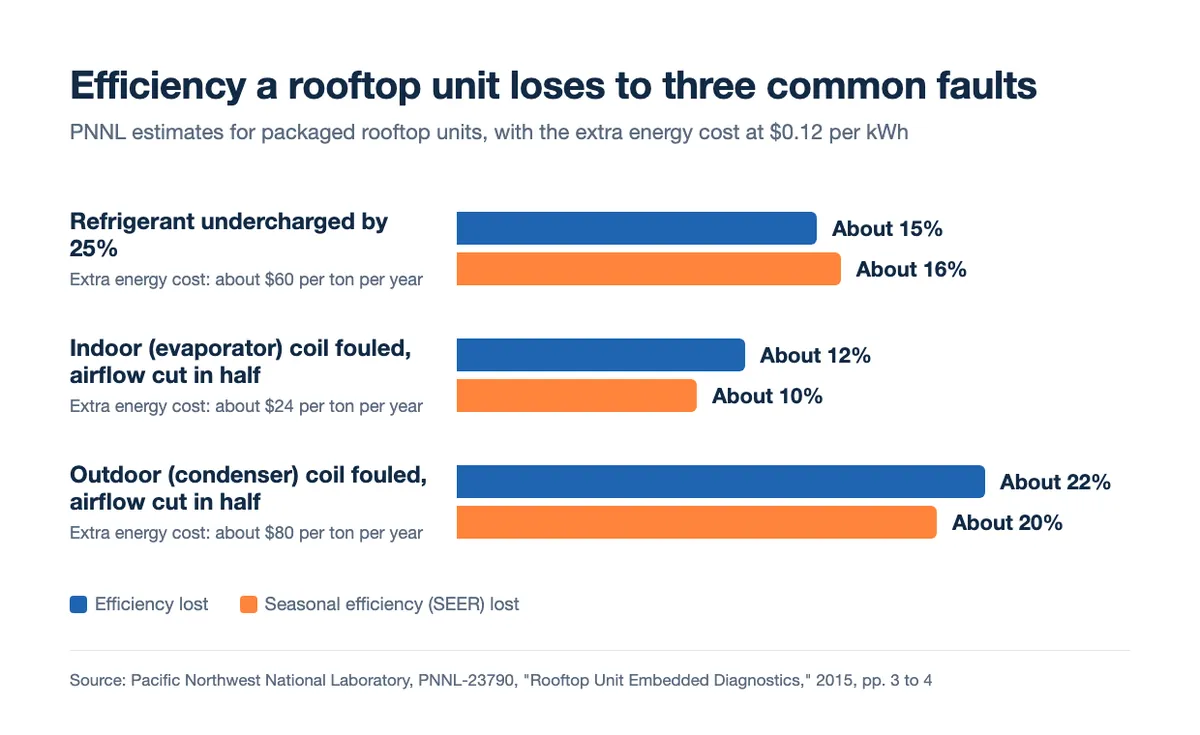
The outdoor coil matters most on a McAllen roof. Condenser coils sit outside on the roof, exposed to whatever the wind carries, and PNNL’s figures show that a badly fouled condenser coil costs more efficiency than either of the other two faults.
Refrigerant charge should be measured against the spec. ENERGY STAR states that too much or too little refrigerant makes a system less efficient, so a proper visit checks the charge against the manufacturer’s specification.
Dampers and economizers fail quietly. PNNL notes that a significant share of rooftop unit economizer controls do not work as intended, and the problems it lists include stuck dampers and excess outside air. In a humid climate like the RGV, a damper stuck open means the unit spends its capacity cooling and drying hot outdoor air it was never meant to take in.
What Neglect Costs in Wasted Energy, and What Maintenance Can Recover
A 10-ton rooftop unit with a badly fouled outdoor coil carries roughly $800 a year in extra energy cost, based on PNNL’s 2015 estimate of $80 per ton per year at $0.12 per kWh, and that is one fault on one unit.
The Department of Energy’s Federal Energy Management Program, in its 2010 operations and maintenance guide, estimates that operations and maintenance programs targeting energy efficiency can save 5% to 20% on energy bills without a significant capital investment. Cleaning coils, correcting refrigerant charge, clearing drains and fixing stuck dampers are exactly the kind of low-cost work that estimate describes.
The failure side of neglect is a separate cost. Mission Air has already written about what a neglected rooftop unit costs when it finally fails, including compressor damage and downtime, and about when a problem calls for commercial AC repair. This post is about the money the unit wastes while it is still running.
Sometimes the answer is replacement, and a good technician will tell you so. ENERGY STAR reports that certified light commercial HVAC equipment is about 17% more efficient than standard equipment. Federal minimums for new commercial rooftop units of 65,000 Btu/h and up also rose for equipment manufactured on or after January 1, 2023. If an older unit keeps losing efficiency after it has been cleaned and charged correctly, it is worth comparing that ongoing waste against what a rooftop unit replacement involves.
Why Spring and Fall Visits Fit a McAllen Building
A rooftop unit in McAllen is best checked twice a year: once in spring before the long run of 90-degree days, and once in fall after the heaviest months of the season.
NOAA’s normals show why the timing matters. McAllen averages about 24 days at or above 90°F in May, 28 to 30 days a month from June through August, 24 in September, and still about 16 in October.
Spring catches what winter left behind. ENERGY STAR recommends checking cooling systems every spring, before the season starts. A unit that has its coils cleaned, its refrigerant charge checked and its drains cleared before June enters the hottest months in better shape.
Fall catches what summer did. By October, a McAllen rooftop unit has run through months of peak load, and a fall visit finds the dirty coils and clogged drains that built up before they carry into another year.
For commercial buildings, the national standard on this is ANSI/ASHRAE/ACCA Standard 180, which sets minimum inspection and maintenance practices meant to preserve a system’s comfort, energy efficiency and indoor air quality.
Mission Air Conditioning is working on a commercial maintenance plan built around those two visits a year. The plan has not launched yet, so ask about its status when you call, and ask about seasonal HVAC maintenance for your building’s units in the meantime.
FAQ
How much of a commercial building’s electricity goes to air conditioning?
About a third of commercial building electricity in the U.S. goes to cooling and moving air. The U.S. Energy Information Administration reports that cooling used about 14% and ventilation about 18% of commercial building electricity in 2018, and in McAllen, about 177 days a year at or above 90°F keep rooftop units running for much of the year.
What is the difference between commercial AC and residential AC?
The practical difference is size and power supply. ENERGY STAR’s residential central AC specification covers single-phase units rated below 65,000 Btu/h, while three-phase units and units of 65,000 Btu/h or more fall under its light commercial HVAC specification. Many commercial buildings are cooled by packaged rooftop units; PNNL reports they are used in 46% of U.S. commercial buildings, and they sit on the roof where nobody inside sees them working.
How often should a commercial rooftop unit be serviced in McAllen?
Every commercial rooftop unit should get at least one pre-season check each spring, and in McAllen a second visit in fall is worth it. ENERGY STAR recommends a spring check for cooling systems, and McAllen’s roughly 177 days a year at or above 90°F put heavy hours on a rooftop unit, so a fall visit catches the wear from the peak months.
Does an older rooftop unit have to be replaced to lower the electric bill?
An older rooftop unit does not always have to be replaced to lower the bill. A 2015 PNNL report found that fixable faults cut a rooftop unit’s efficiency by about 12% to 22% when they are severe: a 25% refrigerant undercharge, or coils dirty enough to cut airflow in half. Cleaning the coils and correcting the charge is the first step. If the unit keeps losing efficiency after that, replacement becomes worth pricing, since ENERGY STAR certified light commercial equipment is about 17% more efficient than standard equipment.
Get a Straight Answer on Your Building’s AC
A rooftop unit that is quietly costing you money usually gives itself away on the bill and in the building long before it breaks. The fix is often as simple as clean coils and the correct refrigerant charge.
Mission Air Conditioning services commercial rooftop units as well as homes, in McAllen, Edinburg, Mission and across the Rio Grande Valley. Take a look at Mission Air Conditioning’s HVAC services, then contact Mission Air Conditioning to have your building’s units checked before next summer’s peak sets your demand charge.