

The technician has finished the diagnosis, the quote is in your hand, and the house is already warm. Now you have to decide: fix the unit one more time, or put that money toward a new system.
In an older McAllen or Edinburg home, that decision is bigger than the unit on the pad. More than half of McAllen’s housing units (54.7 percent) were built before 2000, according to U.S. Census Bureau data. A house that age often has original ductwork, a refrigerant that is no longer made, and an AC sized by a rule of thumb decades ago. Each of those can tip the math.
The checklist below walks through the questions that matter, in the order you can answer them. Mission Air Conditioning can help you fill it in with real numbers. Its repair process starts with finding the root cause, and you get clear, upfront pricing before any work begins, so you can compare both paths without pressure.
How Do You Decide Whether to Repair or Replace Your AC?
Answer each question below, then count which column most of your answers land in. If most land under “leans replace,” a new system is usually the better use of your money. If most land under “leans repair,” fix it and keep the unit on a maintenance schedule.
| Checklist question | Leans repair | Leans replace |
|---|---|---|
| How old is the outdoor unit? (Check the nameplate.) | Under 10 years | Over 10 years; over 15 is a strong signal |
| Age x repair quote (the $5,000 rule) | Under $5,000 | Over $5,000 |
| What refrigerant does the nameplate list? | Any refrigerant other than R-22 | R-22 (also shown as HCFC-22) |
| How often has it needed repairs? | This is the first real repair | Frequent repairs, and the bills keep rising |
| Does the whole house cool evenly? | Yes | Some rooms too hot, humidity problems, or excess dust |
| Is the system unusually noisy? | No | Yes |
| What shape is the ductwork in? | Checked and sealed | Original, taped, never tested |
| Was the unit sized with a load calculation? | Yes, and it keeps up | Unknown, or the house never feels dry |
| When was it installed? | In the last decade | In the 1990s, when the efficiency floor was SEER 10 |
The age, repair-history, comfort, and noise rows come straight from ENERGY STAR’s list of signs it is time to replace. The rest come from the sections below. The reasoning behind the age rule and the 50 percent rule is laid out in how to know when it’s time to replace your AC.
What Is the $5,000 Rule?
The $5,000 rule multiplies your AC’s age by the repair quote, and a result over $5,000 points toward replacement. Trane, one of the major equipment manufacturers, publishes the rule with two examples. A 10-year-old system facing a $300 repair scores $3,000, so repair is likely the better call. The same system facing a $600 repair scores $6,000, and replacement deserves a serious look.
The rule gets strict fast on an older unit. Because age is a multiplier, a small repair on an old system can cross the line that a big repair on a young one never reaches. That is the point: money spent on an old unit buys fewer years.
Use it as a first screen. The rule knows nothing about your refrigerant, your ducts, or your electric bill. The next sections cover what it misses in an older house.
What Changes When Your RGV Home Was Built Before 2000?
An older house adds four questions that a newer one mostly avoids: refrigerant, efficiency, ductwork, and sizing.
Refrigerant. If your system is original to an older house, check whether it runs on R-22. Since January 1, 2020, no new R-22 has been made or imported in the U.S., according to the EPA. Existing systems run on reclaimed R-22 and stock made before 2020. The EPA does not require you to replace an R-22 system, but it also notes there are no “drop in” replacements. Taken together, those EPA facts make a refrigerant leak on an R-22 unit a strong reason to lean toward replacement. The refrigerant type is printed on the nameplate of the outdoor unit.
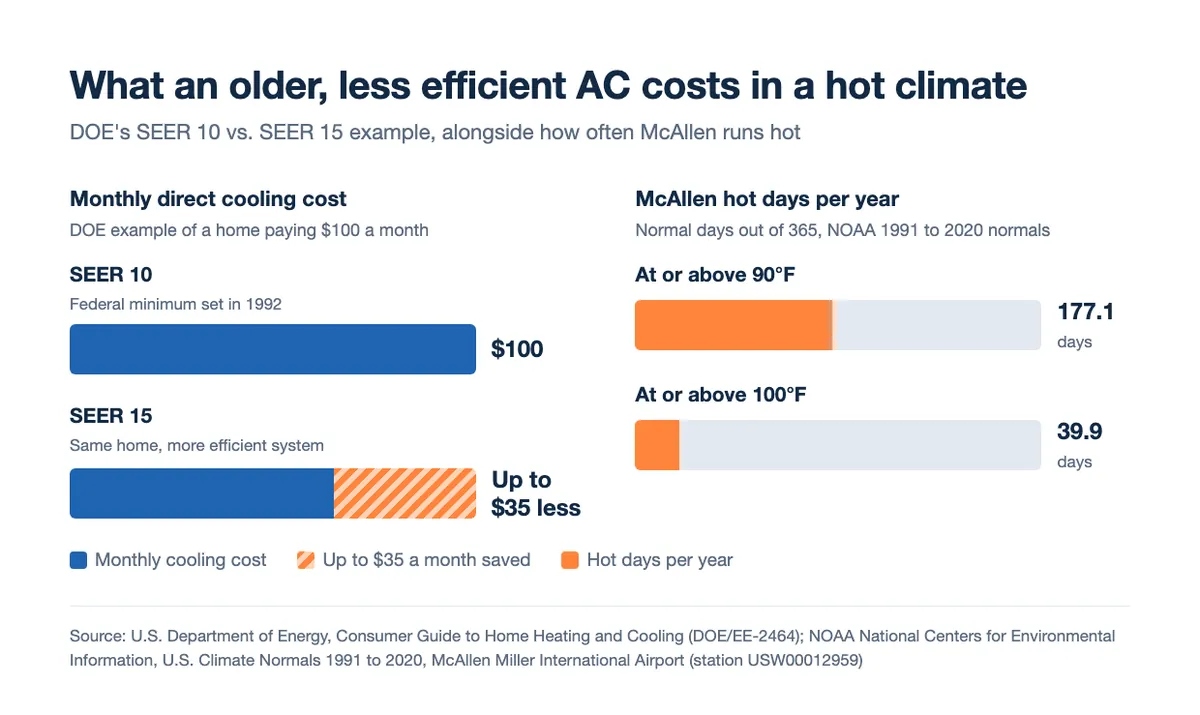
Efficiency. The federal efficiency floor for central AC was set at SEER 10 in 1992, per the U.S. Department of Energy. DOE’s own example: a home spending $100 a month to cool with a SEER 10 unit could cut that by up to $35 with a SEER 15 system. In a climate with about 177 days a year at 90°F or hotter, according to NOAA’s McAllen normals, that gap adds up month after month.
Ductwork. A new unit pushes air through the same old ducts unless someone checks them. ENERGY STAR estimates that 20 to 30 percent of the air in a typical duct system is lost to leaks and poor connections. Texas only made duct leakage testing mandatory for new single-family homes on September 1, 2016, so a pre-2000 house was not required to pass a duct test when it was built. Replacing ductwork is a bigger job: Angi’s national data puts new ductwork at $3,000 to $7,500 per 300 linear feet. Ask whether sealing the existing ducts is enough first.
Sizing. The DOE warns that the old one-ton-per-400-to-500-square-feet rule “fails to take into account local climate and the efficiency of a house,” and that oversized systems can lead to poor comfort, mold, and poor indoor air quality. The right tool is a Manual J load calculation. If your house has new windows, spray foam, or sealed ducts since the original install, the right size may have changed. Read more on what size AC your McAllen home needs.
Which Checklist Answers Point Toward Repair?
Repair is usually right when the unit is under 10 years old and the fix is contained. Trane notes that for systems under 10 years old, repair is typically the most economical choice, and ENERGY STAR uses the same 10-year mark as its first replacement signal.
Repair also makes sense when:
- The $5,000 score is well under the line. A modest repair on a mid-life unit rarely justifies thousands in new equipment.
- The nameplate lists a refrigerant other than R-22. The EPA’s end of new R-22 production does not apply to your system.
- The house cools evenly and stays dry. ENERGY STAR lists uneven rooms, humidity, and dust as replacement signs, so a comfortable house counts in the unit’s favor.
- This is the first real repair in years. One failure is not a pattern.
If you are still sorting out how serious the problem is, start with whether your problem is a quick fix or a bigger repair.
Keep a repaired unit on a schedule. Mission Air’s Mission Care Plan includes two tune-ups a year and 10% off repairs, which helps an aging system earn its remaining years. It also carries a $500 loyalty reward toward a new system when the time comes.
When Does Replacement Make More Sense in the RGV?
Replacement makes more sense when several “leans replace” rows line up, especially age, R-22, and rising bills. The DOE says a system over 15 years old can save you money on electric bills if you invest in new equipment. ENERGY STAR says replacing an AC over 10 years old with an ENERGY STAR unit, installed correctly, can save up to 20 percent on heating and cooling costs.
The RGV runs equipment hard. NOAA’s 1991-2020 normals for McAllen show about 40 days a year at 100°F or hotter. Nationally, the DOE puts a central AC’s life span at 15 to 20 years. Heavy year-round runtime is why the local picture is shorter, and how long an AC lasts in the Rio Grande Valley gives the RGV range.
Know the price range going in. Angi’s 2026 national data puts AC replacement at $5,978 on average, with a range of $1,400 to $12,500, against $450 to $2,000 or more for repairs. For local numbers, read what AC replacement costs in McAllen. Mission Air also offers financing options for homeowners who need to spread the cost.
Speed matters in the heat. In a 100-degree week, a failed unit is a health risk for everyone in the house. One Google reviewer with a rental home wrote that Jose, Mission Air’s owner, installed a new system “within less than 36 hours of initial contact.”
What Should You Ask Before You Sign Either Quote?
Ask questions that make both quotes comparable. A good contractor will answer all of them without hesitation:
- What refrigerant does my current system use, and what will the new one use?
- What is the $5,000 score on this repair?
- Did you look at the ductwork, and does it need sealing or repair?
- How did you size the new system? Was it a load calculation?
- Is the price in writing before any work begins?
Mission Air Conditioning’s AC replacement process starts with an in-home assessment of your home’s size, layout, insulation, and comfort needs, with no upselling, and ends with testing and a walkthrough before the crew leaves. Its AC repair process gives you the price before any work begins.
Holding a quote and not sure which way to go? Explore Mission Air’s HVAC services and ask for a straight read on your system. You will get both paths laid out honestly, and the decision stays yours.
FAQ
What is the $5,000 rule for AC units?
The $5,000 rule says to multiply your AC’s age by the repair cost and consider replacement if the result tops $5,000. Trane’s example: a 10-year-old unit with a $600 repair scores $6,000, which points toward replacing.
What is the average cost to replace an AC?
AC replacement averages about $5,978 nationally, with most projects between $1,400 and $12,500, according to Angi’s 2026 data. Ductwork changes, system size, and efficiency level move the final number the most.
What is the average lifespan of an air conditioner?
Nationally, a central air conditioner typically lasts 15 to 20 years, according to the U.S. Department of Energy. In the Rio Grande Valley, heavy year-round runtime shortens that, as Mission Air’s guide to how long an AC lasts in the RGV explains. ENERGY STAR suggests considering replacement once a unit passes 10 years, and says an ENERGY STAR model installed correctly can save up to 20 percent on heating and cooling costs.
Can I keep running my R-22 system?
Yes, the EPA does not require homeowners to replace working R-22 equipment. New R-22 has not been made or imported since January 1, 2020, so repairs that need refrigerant depend on reclaimed supply, and there are no drop-in substitutes.
Should I replace the ductwork when I replace the AC?
Replace ductwork only if an inspection shows it is damaged beyond sealing. ENERGY STAR notes that sealing existing ducts can cut leakage and may even let you choose a smaller system that removes humidity better.